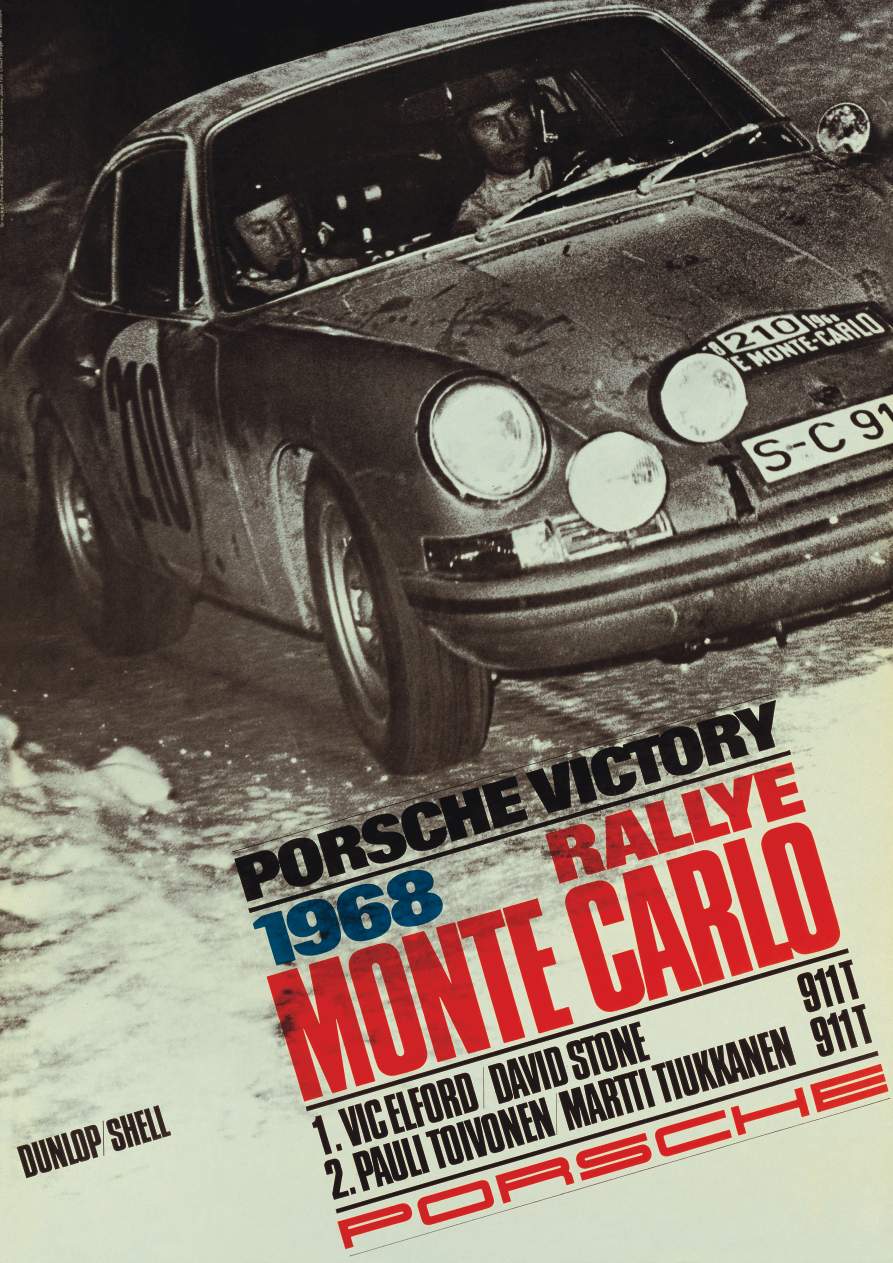
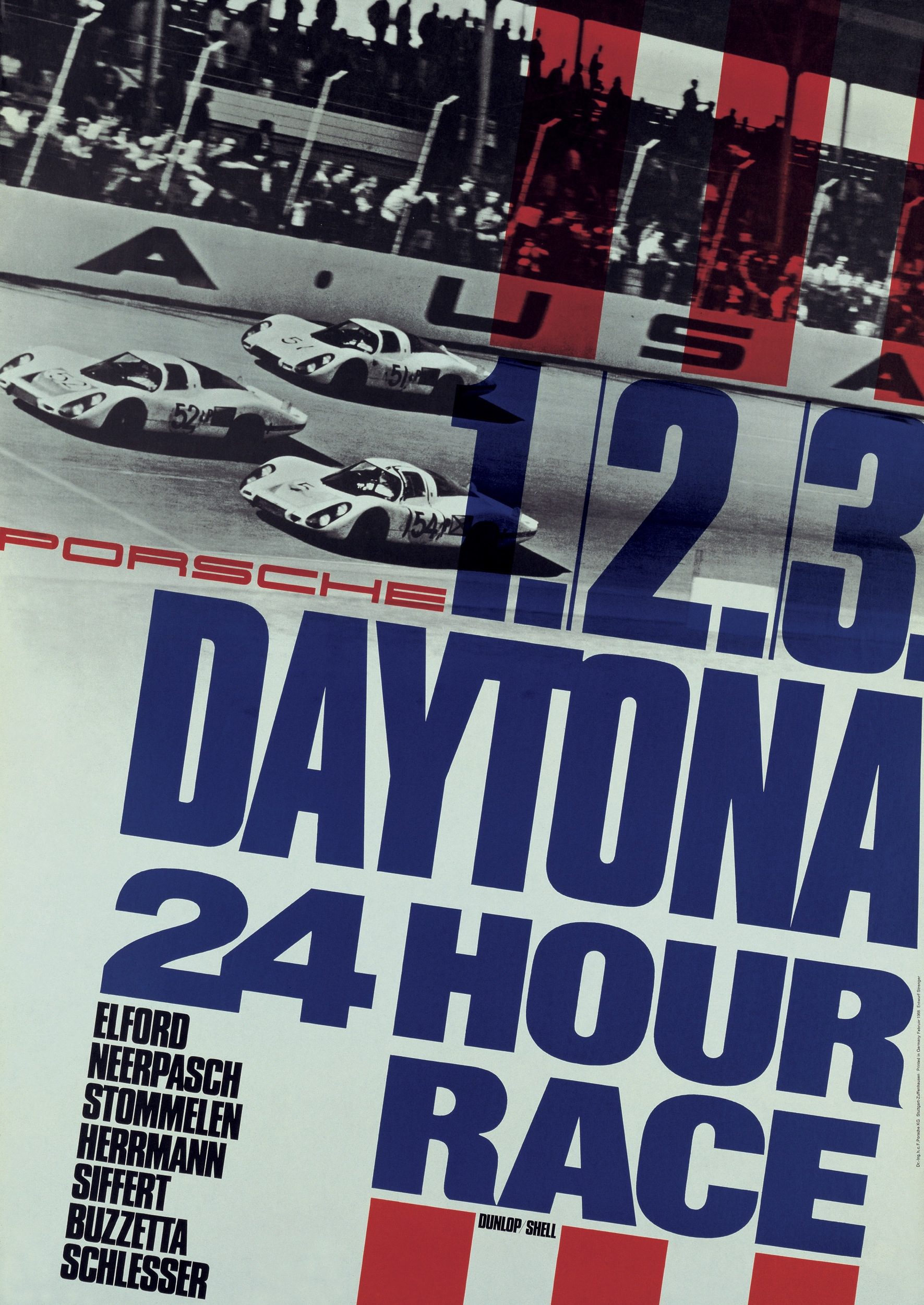
Porsche’s racing posters from the 60s and 70s still look amazing today. Designed by Erich Strenger, they were made when Porsche won a major race or championship, which was basically every month back then.
One of the main reasons why the 60’s were the golden era of racing was that the best drivers usually competed in multiple series at once. Drivers weren’t paid nearly as well as they are today, so many of them had to take whatever drives they could get. It was a big win for fans, who got to see the world’s best battle each other in F1, Indy cars, sportscars, Can-Am, touring cars, and even rally. Contracts barring a driver from racing with a rival manufacturer were also rare, unlike today. Porsche was one of the first manufacturers to introduce the idea of a factory driver, who was under contract to race with them. “Quick Vic” Elford was the only Porsche driver to compete in both road and rally racing. Unlike his Porsche teammates, Vic started his career in rally, but he was equally fast in a sportscar. Known for his car control skills and excellent memory, he was one of the only drivers of his era or any other to compete at the top level of rally and sportscars at the same time. In 1968, Vic won the Monte Carlo Rally and the 24 Hours of Daytona within one week, with some help from the racing gods.
Drama In Monte Carlo
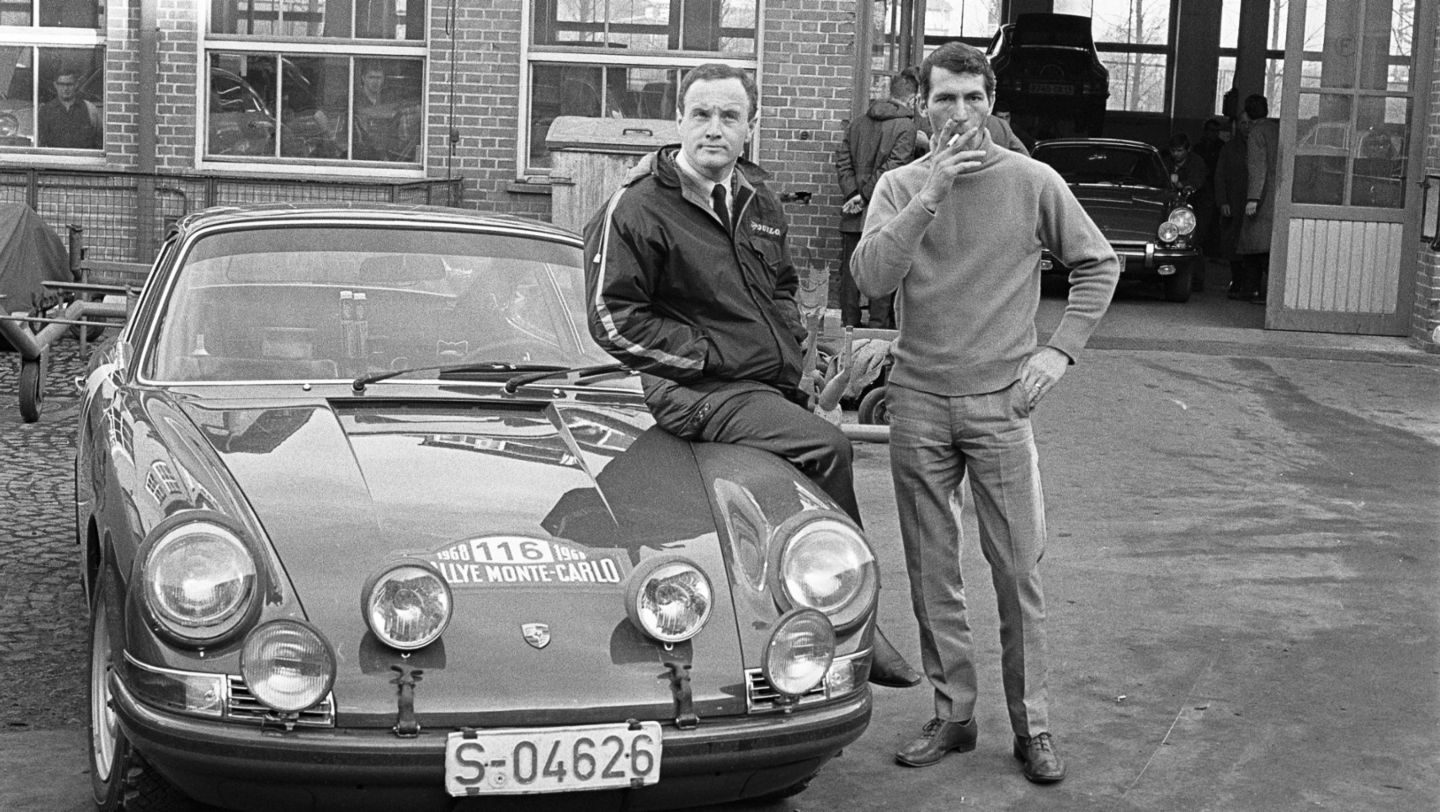
Vic Elford, smoking a cigarette and looking suave as usual, poses for a photo with his co-driver, David Stone.
Porsche had entered the 911 in the Monte Carlo Rally since 1965. A lightly modified 911 2.0 was entered in the 1965 Rally, driven by Peter Falk and Herbert Linge. It was the 911’s first-ever race, and they finished fifth overall out of more than 200 starters. The 911 proved to be an excellent rally car, and Vic Elford won the world’s first rallycross race in one. He only lost the 1967 Monte Carlo Rally after the works Mini of Rauno Aaltonen went off a cliff at over eighty miles an hour on the final stage and somehow not only survived, but saved time and won the rally overall (they didn’t tell anyone about the shortcut for over twenty years)! In 1968, Porsche prepared two 911 T, which would be driven by Vic Elford and Pauli Toivonen.
The rally had used a handicap system for several years, allowing slower cars like the Mini a chance to fight for overall victory. But it was gone for 1968, so the competition was between Porsche, Alpine, and Lancia for the overall win. The rally was run in two “circuits”, the first was a 1500km route of roads and 7 special stages, and the second had 600km of roads and 11 special stages. Vic took practice very seriously, checking that all his pace notes were accurate and driving the stages at the actual start time.
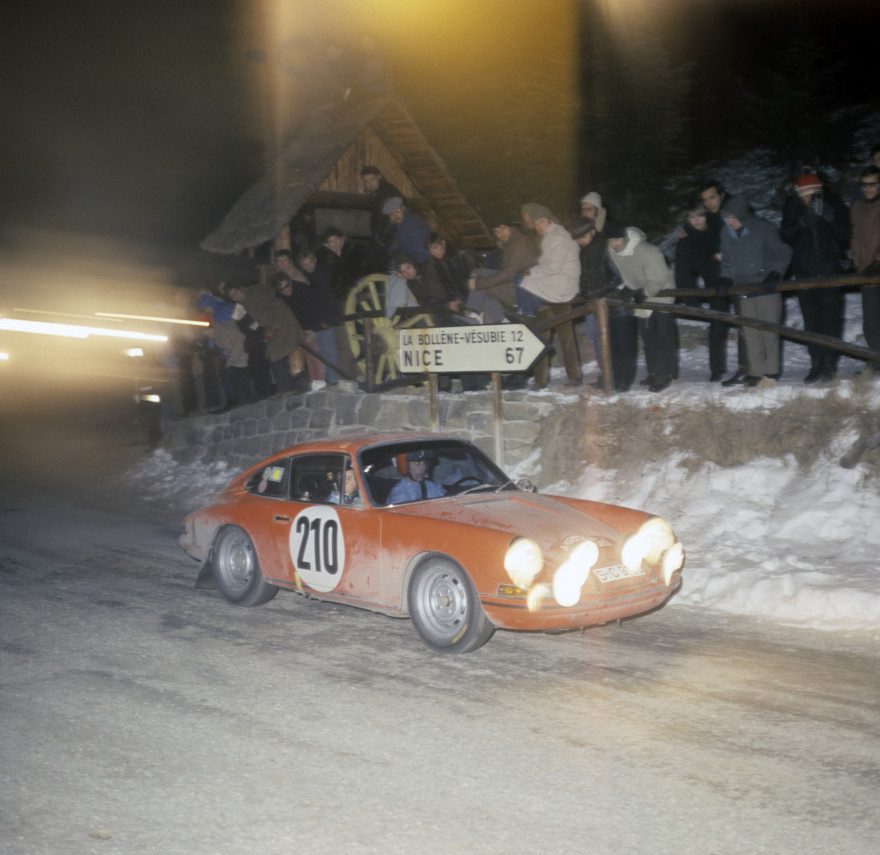
It’s a car that needs to be gently coaxed, and persuaded, and seduced, but never bullied. Treat it with finesse – everything smooth and gentle, because if you try to bully a 911, it will bite you. – Vic Elford
After the first circuit, Vic was in third place behind the Alpines of Gerard Larrousse and Jean-Francois Piot. Vic struggled on the first two stages of the second circuit and finished 31 seconds behind Larrousse. Vic had to go for broke on the third stage, and he did, hitting over 120 mph on icy roads, clawing back the 30-second gap, and taking the lead by 20 seconds. “I had never stretched myself, particularly my nerves, to such an extent before,” he later said.
On the fourth stage, Larrousse tried to catch up, but 200 meters from the top, a group of spectators had dumped snow onto the road, and Larrousse spun and crashed. Larrousse got into a fistfight with them, which continued until the police arrived and arrested the spectators. So Vic won, and Pauli Toivonen finished second. This was the first victory for a rear-wheel-drive car since 1960. But Vic had to hop on a plane and get to Daytona Beach.
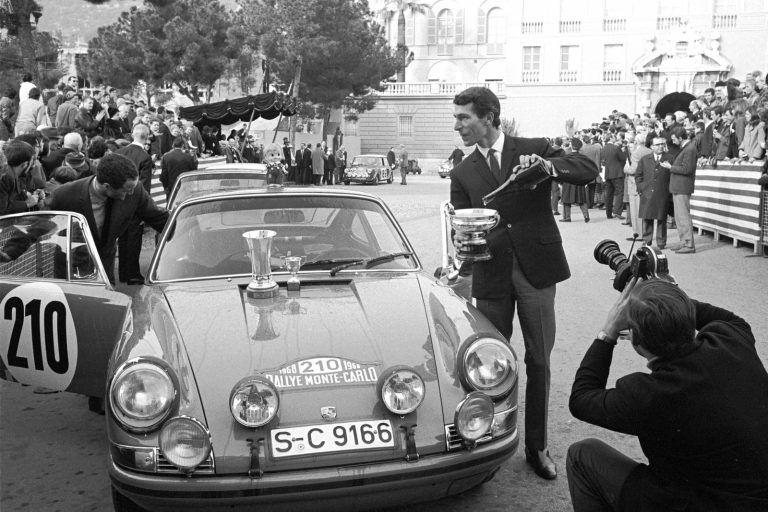
It may not have the fame of the Grand Prix, but the Rally is just as difficult to win. Plus, you still got the trophy from Princess Grace and champagne. Not sure if mixing the two together is a good idea, though.
Daytona
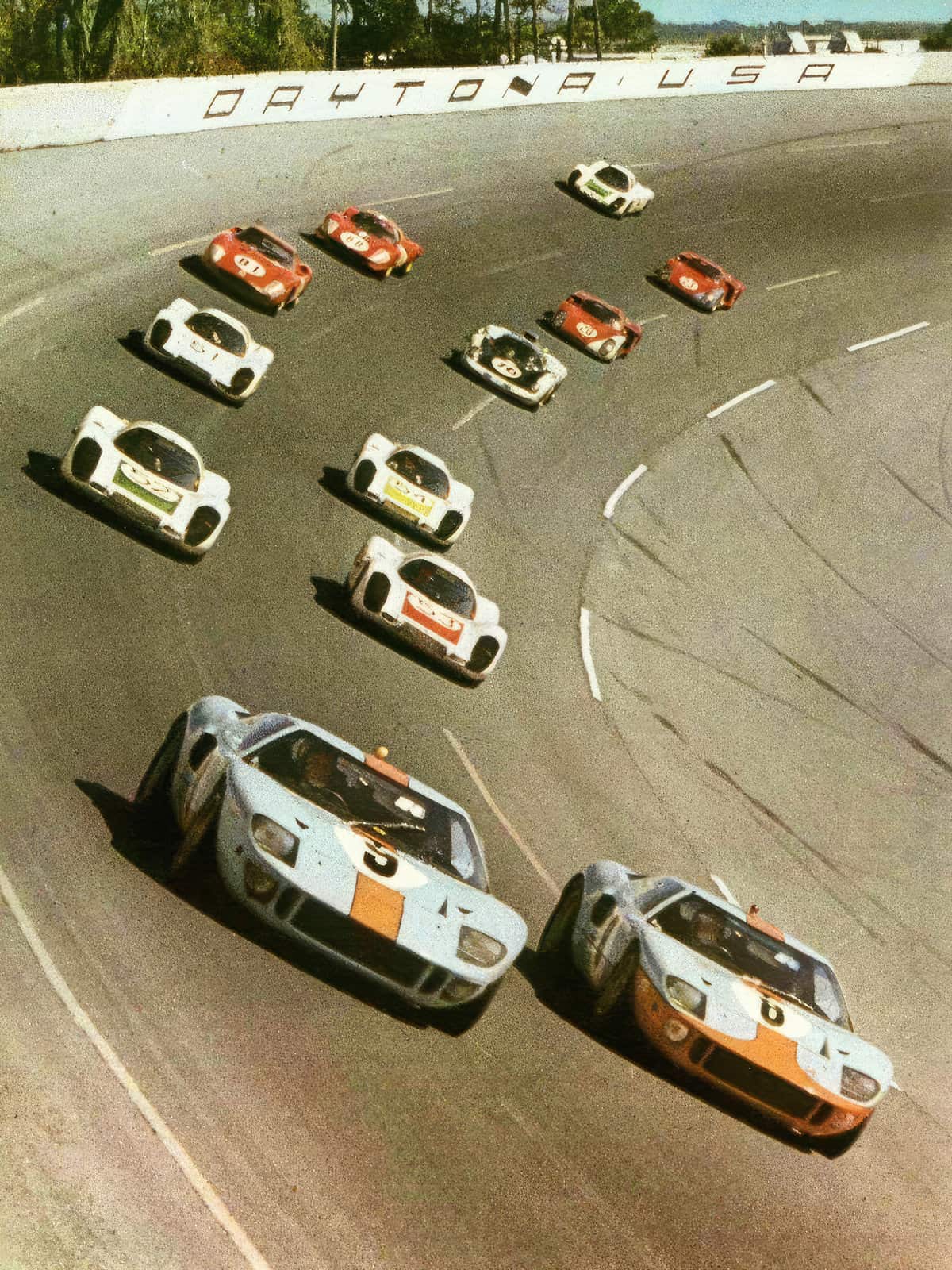
The start of the 1968 Daytona 24 Hours. The Gulf GT40s lead the four works Porsche 907 LHs, followed by a Ferrari 250 LM, a Howmet TX, a Ferrari Dino 206 S, two Alfa Romeo T33/2s, and a privateer Porsche 907 LH.
Less than a week later, Vic arrived at Daytona. 1968 was only the third edition of the race since switching to the 24-hour format. Ford and Ferrari had won the inaugural two races, but the FIA had limited prototype engine capacity to 3.0 liters for 1968, which meant Porsche’s little prototypes could now compete for overall wins. Ford, Ferrari, and Chaparral had no cars for the 1968 season, so the race would look very different from the previous year. Alfa Romeo debuted their gorgeous new T/33/2. John Wyer used a loophole to enter two 5-liter Gulf Ford GT40s. A wild card was the turbine-powered Howmet TX, which was quick but totally unproven.
Porsche’s works team entered four 907 LHs to compete for the overall win. The 1300-pound 907 LH was designed with Ferdinand Piech’s low-drag philosophy, and while its top speed was much higher than the 910’s, it was very difficult to drive at high speeds. It was also the first right-hand-drive racing Porsche since the Gmund 356 (although the cockpit was so narrow that it was effectively a central-seater), and RHD has been a hallmark of Porsche prototypes ever since.
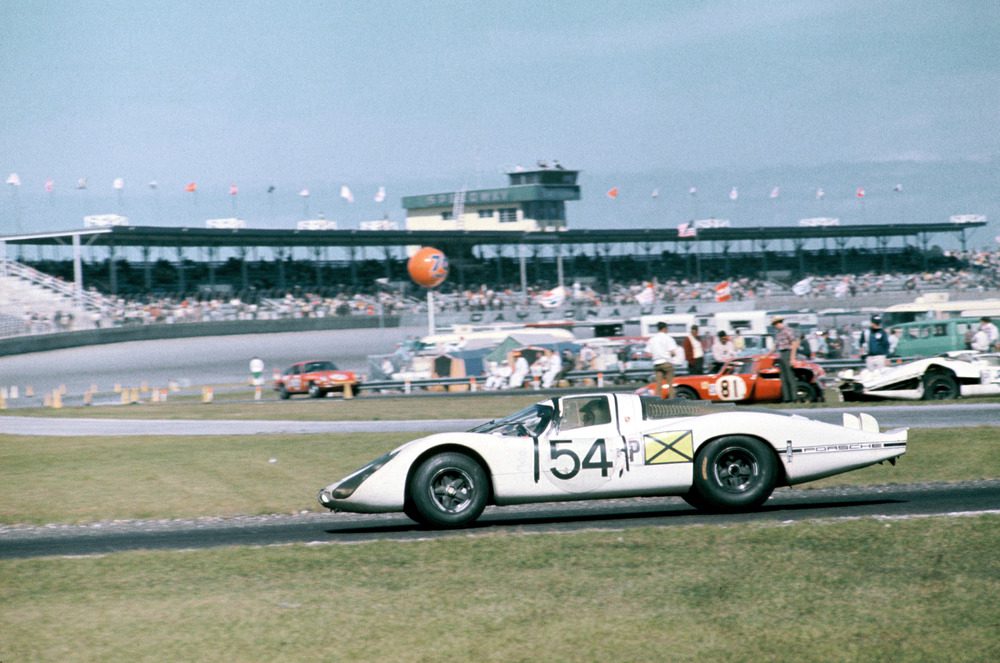
When you came off the main banking on the tri-oval and came across in front of the main grandstand and got off the throttle, it would do the same thing – a lot of yawing and darting. That was at about 200 miles an hour! – Joe Buzzetta
It was powered by the spectacular Type 771 flat-eight, finally reliable after years of development pains in F1. Porsche brought an aluminum-chassis 907 LH to Daytona in December 1967 to test several innovations, including an ice-powered driver cooling system. The car didn’t finish the full 24-hour test after it flipped on the high banks with Jochen Neerpasch at the wheel. Joe Buzzetta, one of Porsche’s drivers, said, “When you came off the main banking on the tri-oval and came across in front of the main grandstand and got off the throttle, it would do the same thing – a lot of yawing and darting. That was at about 200 miles an hour! On the banking they did the yawing too. With your steering wheel held firm the car would go up and down the banking by itself.”
But Porsche’s engineers were not concerned about their car’s sketchy handling. “There was nothing we could do about it. Piëch said the long-tail was faster than the short-tail, and that’s all they cared about. They felt that you had to acclimate yourself to their cars.” Buzzetta said. Piech and his engineers were ruthless, and even fire extinguishing systems would be removed on race day to save weight. After another crash in practice, the aluminum-chassis test car was rebuilt and entered the race.
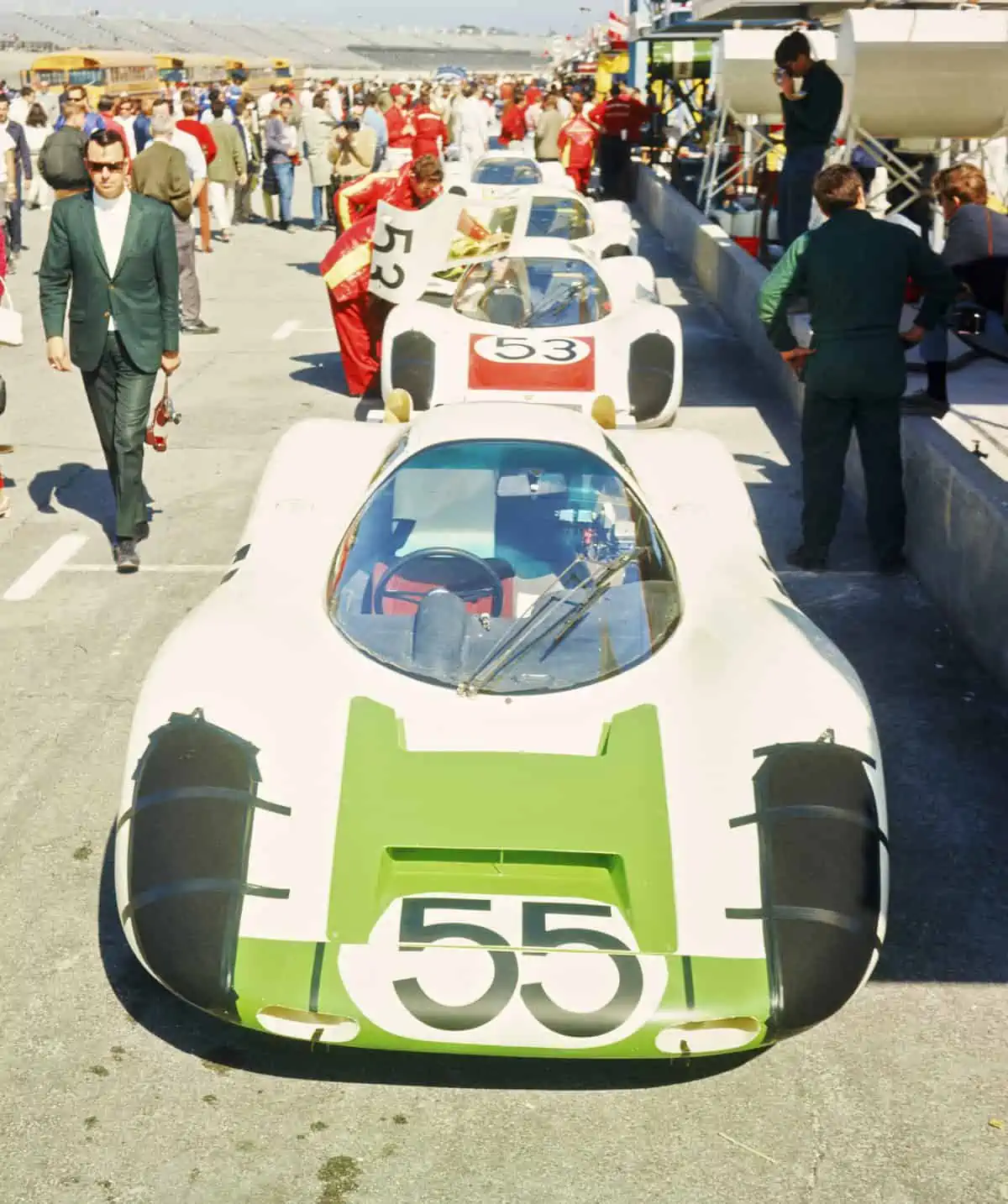
Porsche’s 917s had some of the best racing liveries ever, but I also love the white-and-bold-color contrast of the Works Porsches before 1970.
There were five 907 LHs lined up on the grid for the race. Vic and Jochen Neerpasch drove the #54 car, Jo Siffert and Hans Hermmann drove the #52, Jo Schelesser and Joe Buzzetta drove the aluminum-chassis #51, Gerhard Mitter and Rolf Stommelen drove the #53, and Rico Steinemann and Dieter Spoerry drove the semi-Works Squadra Tortuga entry. Like most endurance races of the era, the attrition rate was very high. The Gulf GT40s locked out the front row in qualifying, followed by all four works 907s. The GT40s were easily the fastest cars, and the Ickx/Redman car led until its gearbox broke. The Alfas were run well under their limits, and they finished fifth, sixth, and seventh (Alfa was happy enough with the result to nickname the car “Daytona”, which stuck).
The Howmet TX was as quick as the Porsches, but it crashed into a wall after the throttle stuck on lap 42. The leading 907 of Gerhard Mitter and Rolf Stommelen flipped on the banking after a rear tire failure and an oil spill, and slid down the banking on its roof. Masten Gregory’s Ferrari 250 LM was caught up in the crash and went airborne at over 150mph, and the Squadra Tortuga 907 LH slid on oil and hit the other two cars. Vic just missed the oil and swerved just in time to avoid the chaos. The other GT40 of David Hobbs and Paul Hawkins had several issues, but it charged back through the field and led from sunset to midnight, when it had brake issues.
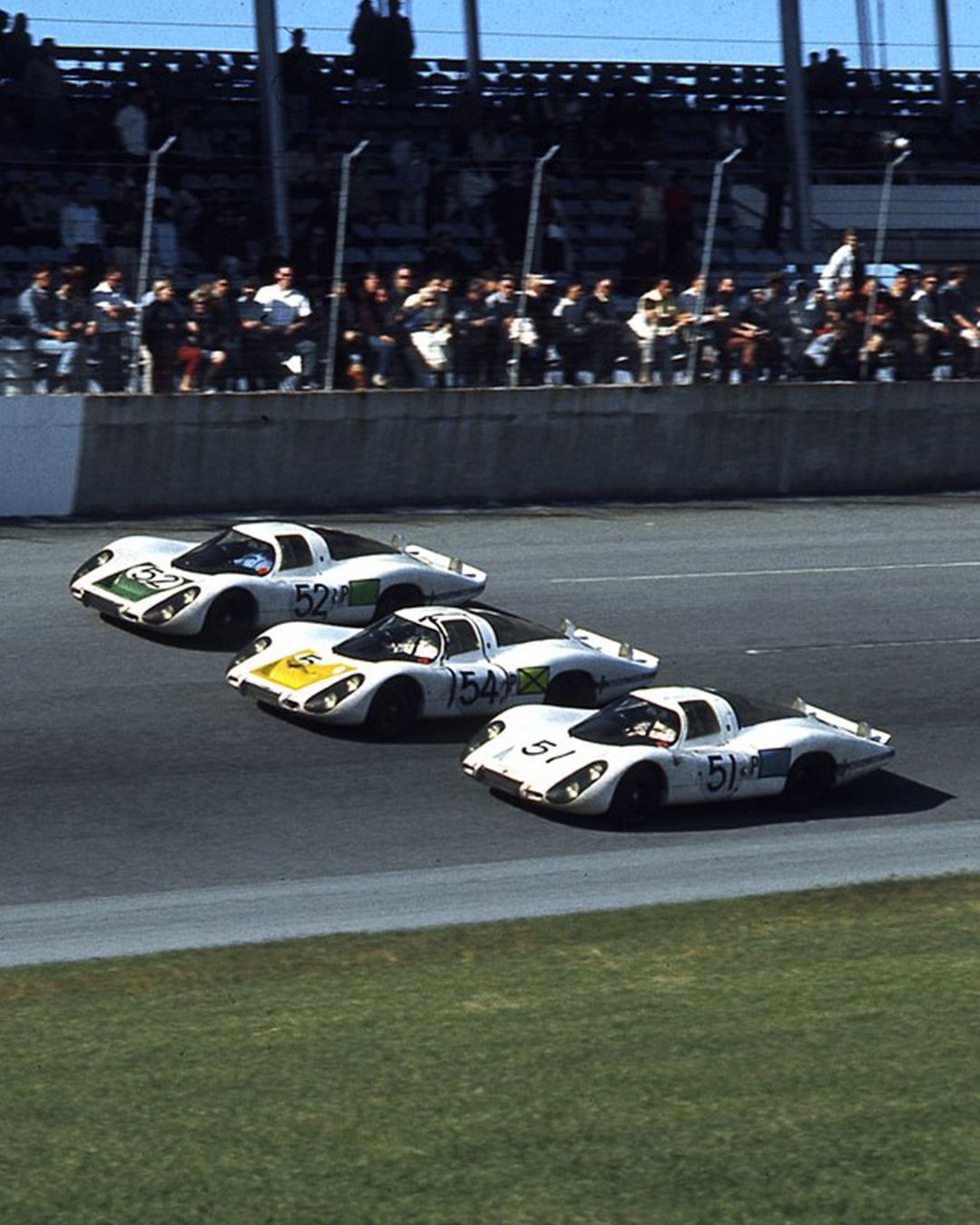
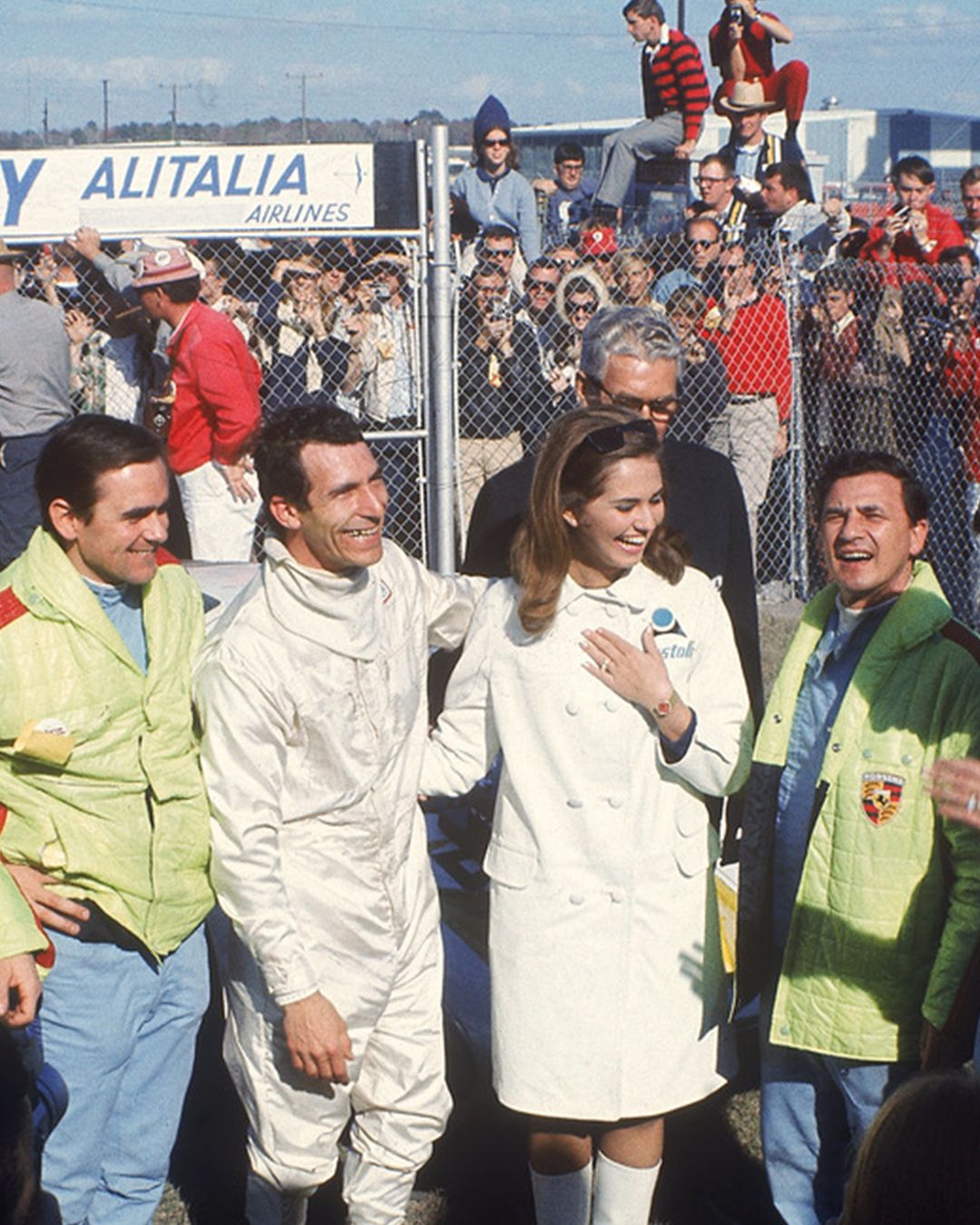
The 907s line up for a 1-2-3 Finish at Daytona. The #54 in the center was the race winner by 14 laps over the other two Porsches. Vic Elford (in white) stands with Jochen Neerpasch, Hans Herrmann, and Miss Universe, who presented the trophy.
At six in the morning, the GT40 retired, and the Porsches just had to finish to win. Jo Siffert and Hans Herrmann had easily led most of the race, but a broken throttle linkage cost them the lead. Team manager Huscke Von Hanstein decided to put several of his drivers in the leading #54 car. While most assumed he wanted to give credit to his best drivers, he claimed it was done to “keep the quick one in front.” So Elford, Neerpasch, Herrmann, Siffert, and Stommelen all received credit for the win. The #54 907 LH finished the race at a 106 mph average speed, higher than the previous year’s winning Ferrari 330 P4 and only 2 mph slower than 1966’s winning MKII GT40, despite having an engine nearly three times smaller than the Ford.
Porsche finished 1-2-3, followed by a Shelby Mustang and the three Alfas. 1968 was the best season of Vic’s career, as he also won the Nurburgring 1000KM and the Targa Florio in his greatest-ever drive. After losing a tire on the first lap at the Targa, he broke his own lap record three times and drove back to seventh place. His teammate, Umberto Maglioli, got to fourth place, and Elford got back in the car to win by over three minutes. He was the only driver pictured on a Porsche poster, because, as engineer Helmuth Bott said, for once it wasn’t Porsche that won the race; it was the driver.
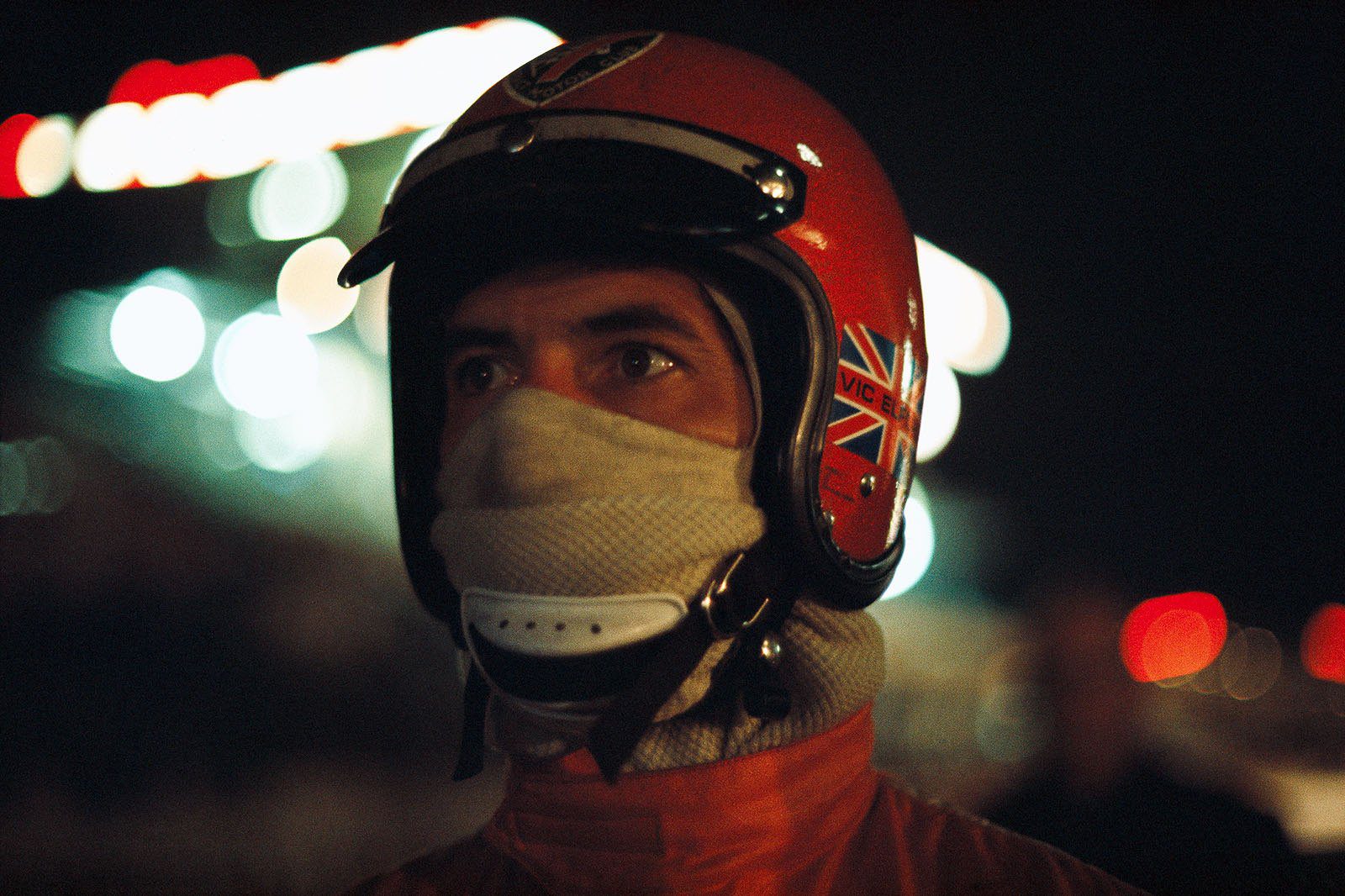
Whatever I did in a car I could always do it, whether it was driving downhill on ice or snow, or driving down the Mulsanne straight at night at 250 mph in a 917. It was the one thing I could do well. – Vic Elford
Photo Credits: Porsche, Revs Institute, Rainer W. Schelgelmilch