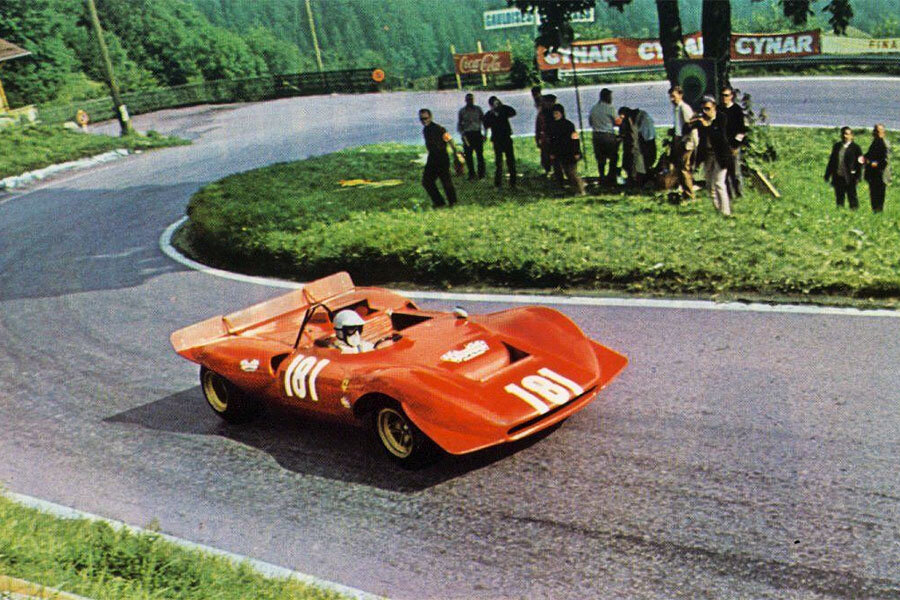
Peter Schetty rips up a hillclimb in his screaming flat-twelve powered Ferrari 212 E Montagna.
Hillclimbing has always been relatively obscure in the motorsport world, but it is one of the most exciting forms of racing. Watching all kinds of different machines – from tiny cars that are borderline go-karts to massively powerful modified ones making four-digit horsepower, tackle courses that require patience as much as courage never gets old. While today’s hillclimb cars are usually heavily modified beasts built by independent teams, in the 60’s many iconic sports car manufacturers built and entered their own cars. Porsche and Ferrari were at the forefront of the European Hillclimb Championship (sometimes known as the European Mountain Championship) in this era, and their rivalry resulted in some of the most extreme racers ever built. The championship was sanctioned by the FIA and featured a vast variety of cars, from lightly modified road cars to full-blown prototypes and even open-wheelers. (although those couldn’t score points) While the purpose-built hillclimb cars have remained obscure compared to their road racing counterparts, they are still a fascinating part of Porsche and Ferrari history. The books Porsche Competition Cars by Bill Oursler and Porsche: Excellence Was Expected by Karl Ludvigsen were extremely useful in researching the Porsche side of this story, and I would recommend reading them if you would like to learn more about these cars.
The Giant Killers
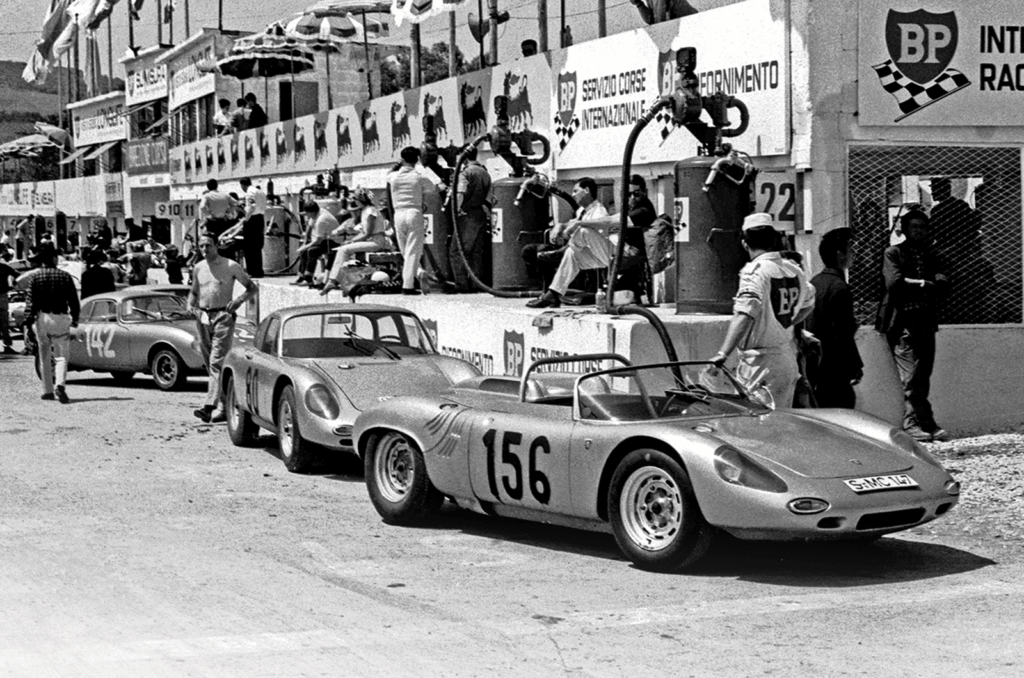
The only 718 W-RS “Grossmutter” at the Targa Florio. Not many racecars win their class at Le Mans three times, but this car did – along with two European Hillclimb Championships.
By the mid-1960s, Porsche had the deserved reputation as the giant killer of sports car racing, as their 356s, 550s, and 904s punched well above their weight thanks to their solid reliability, and hillclimbs suited Porsche’s lightweight racers very well. So well that Porsche won the first four European Hillclimb Championships from 1957 to 1961. But the giant of racing that Porsche couldn’t slay was Ferrari, as Ferrari usually only raced in the larger displacement classes. The 60s was Ferrari’s golden era, where they dominated sports car racing, and were extremely successful in F1. For 1961, Porsche built the new 718 W-RS, a car that deserves an article all to itself. The 718 W-RS was a 718 RSK with a longer wheelbase that was built to use the Type 771 F1 flat-eight, but that engine wasn’t ready yet, so it used the legendary Fuhrmann four-cam engine for the 1961 World Sportscar Championship. For 1962, now powered by the Type 771, it was entered in the hillclimb championship and driven by Edgar Barth, the father of Porsche racer and historian Jürgen Barth. While Ferrari GT cars like the 250 GTO were occasionally raced on hillclimbs by privateers, the Works team had never entered anything especially suited for hillclimbing. That changed with the new Dino 196 SP, a lightweight prototype that was extremely capable on a hillclimb, especially with Ludovico Scarfiotti at the wheel.
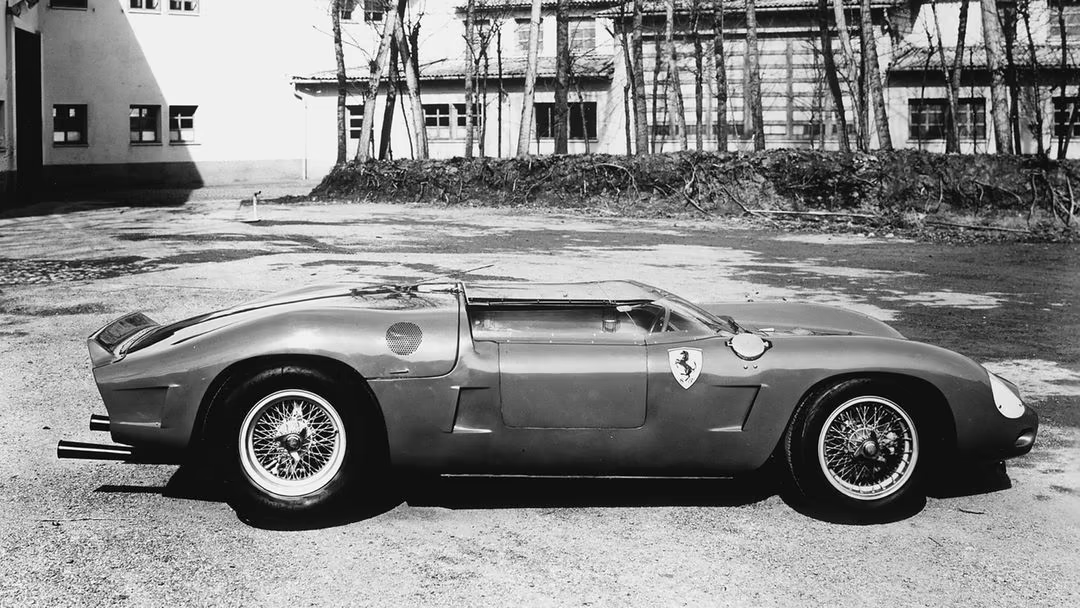
The Ferrari Dino 196 SP was the first car to beat Porsche in the European Hillclimb Championship.
Scarfiotti was one of Ferrari’s top drivers, winning many of the major sportscar races of the day, but he was still relatively new to Ferrari in 1962. The V6-powered Dino was more than a match for the W-RS, and Scarfiotti easily won the 1962 championship against the Porsche with four wins out of seven events. But Ferrari pulled out of the championship for 1963, leaving the W-RS and Barth to easily win the next two championships. Edgar Barth tragically died of cancer in 1964, leaving Porsche without their champion hillclimber. The W-RS retired in 1964 as arguably the most successful single Porsche chassis ever made with three class wins at Le Mans, two European Hillclimb championships, and solid finishes at the Targa Florio and Nurburgring. The team nicknamed it Grossmutter (grandmother) for it’s long career. Porsche’s new racing boss was Dr. Porsche’s grandson Ferdinand Piech, who needs no introduction in the automotive world. But back in the early 60’s, Piech was just starting his career, and he was obsessed with constantly improving and evolving his cars – especially when it came to reducing weight.
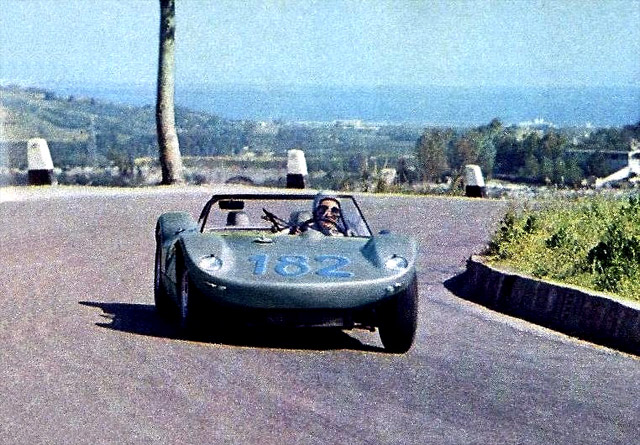
The 904 Bergspyders often jumped in the air on bumpy roads, which earned it the nickname “Kangaroo”. This car, chassis 007 was the first 904 Bergspyder built and featured a very unique body.
Porsche’s 904 had proven itself as a capable racer, but Piech didn’t think there was much else that could be done to improve it. And the 904 now had a serious rival in the new Ferrari Dino 166 P, a little mid-engine prototype that was very capable at kinds of tracks. So work began on the first of the Bergspyders (Mountain Spyders), Porsche’s specialized hillclimb weapons – although the first wasn’t nearly as radical as its successors. Piech decided that the new car should be open to save weight. But the 904’s box frame chassis and fiberglass body already weren’t very rigid, and adding a lightweight open body didn’t help at all. The prototype flat-eight 904 Bergspyder was a handful to drive at best, and even the often overconfident Jo Bonnier refused to drive it in the 1965 Targa Florio. But it was fast, finishing second overall at the Targa. Five 904 Bergspyders or “Kangaroos” were built, including the prototype. These Bergspyders weighed less than 1,300 pounds, about 250 pounds lighter than the 904/8 coupe. Unfortunately for Porsche, Ferrari’s new Dino 166 P was more than a worthy competitor.
Piccolo Prototipo
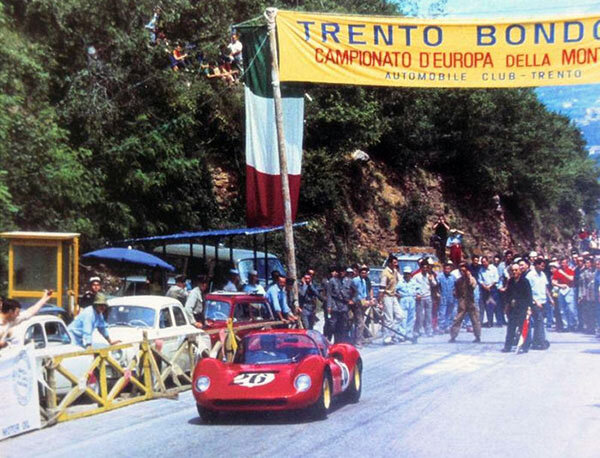
Ferrari’s Dino series of prototypes was far more reasonable than Porsche’s Bergspyders, as they were designed for endurance races and not just a short blast up a hillclimb.
The little Dino V6, designed by Vittorio Jano, was new territory for Ferrari, but it was the perfect engine for the job of hillclimbing. The new 166 P was just as competitive in its class at Le Mans as it was at the twisty roads of the Targa Florio. The forward-thinking semi-monocoque chassis was far more rigid than the 904s. And it was so quick that Porsche demanded that the stewards tear down the 166 P after the Nurburgring 1000KM, because they couldn’t believe that it was only a 1.6-liter engine. But Ferrari decided it should be even quicker, and upgraded the engine to 2 liters. The resulting 206 P made 205 horsepower and weighed only 1,291 pounds. Ferrari entered a 206 P in the 1965 European Hillclimb Championship for Ludovico Scarfiotti, but they missed the first two rounds of the season due to other racing commitments. Porsche brought two 904 GTS and a Bergspyder, and Abarth also entered a new 2000 OT Spider for Hans Herrmann. Abarth won the first round of the season at Mont Ventoux in France, and Porsche won the second at Germany’s Rossfeld.
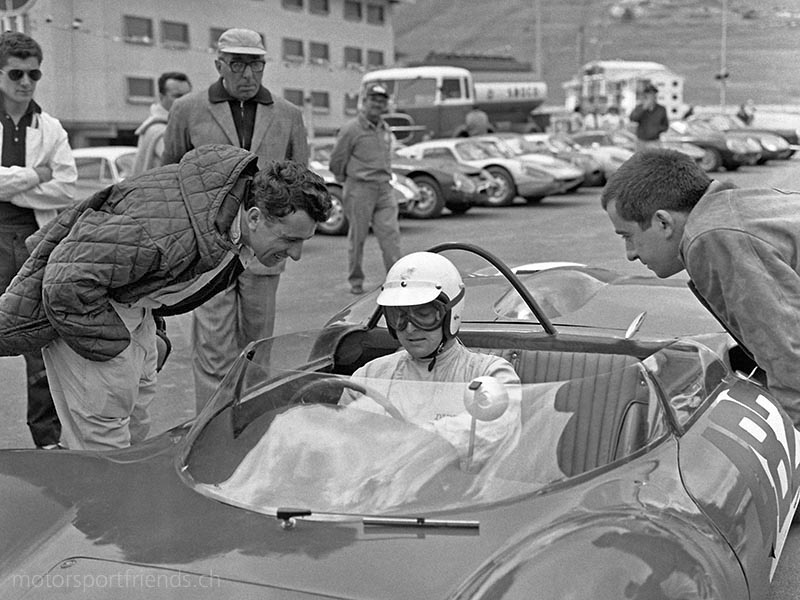
Ludovico Scarfiotti shows the new Dino 206 S to Gerhard Mitter at the 1965 Cesana-Sestriere Hillclimb.
This wasn’t too much of a problem for Ferrari, as Scarfiotti showed up to Italy’s 13-mile Trento-Bondone hillclimb and destroyed the course record by 21.4 seconds. The 206 P then went back to Maranello for new Spyder bodywork, which lowered its weight to only 1,172 pounds. By July 1965, Piech was frustrated with the 904’s inherent compromises and decided that a brand new car was needed. The new car, known as the 906 “Ollon Villars Spyder” (after the Swiss hillclimb) was the first Porsche designed under Piech’s command, and it was built in only three weeks. It was built on a new tubeframe chassis, with the flat-eight and transmission from the 904 Bergspyder. Piech wanted F1-style suspension and smaller wheels, but there wasn’t enough time for Porsche to make their own. So Piech made the bold choice to purchase suspension uprights and 13-inch rims from Lotus at the German Grand Prix. The Ollon Villars Spyder was only entered in its namesake event for 1965, driven by Gerhard Mitter, where it finished second behind Scarfiotti’s Dino. Mitter was a mechanic who took up motorcycle and then car racing, and he was at his best on tight, twisty routes like the Targa Florio. He quickly became Porsche’s number one hillclimb driver after the death of Edgar Barth. Scarfiotti easily won the following two events and won the championship with fifth place at an icy Gaisberg.
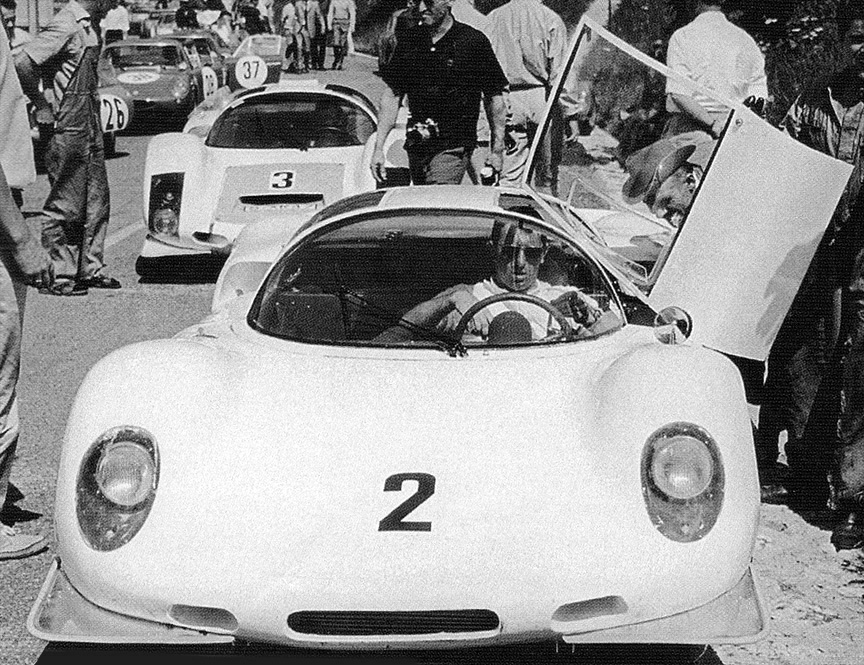
The 906 “Ollon Villars Spyder” was a very interesting car and also the first 906 ever built, although the production 906 was quite different.
Another interesting footnote in the Ollon Villars Spyder’s history is that it set the first FIA-recognized quarter-mile record. Husch Von Hanstein drove the standing quarter-mile in 11.892 seconds at an average speed of 75.78 mph, on wet pavement no less. For 1966, the 906 Ollon Villars Spyder was converted to Targa configuration to comply with the updated rules. It would be the main gun in Porsche’s arsenal, along with Hans Herrmann in a standard 904/8. Ferrari brought the Dino 206 S, with Scarfiotti at the wheel as usual. The first round at Rossefeld was won by Mitter, with his left foot in a cast, somehow beating Scarfiotti by five seconds. Ferrari couldn’t compete in the full season due to strikes at the factory, and Porsche took the title with six wins to Ferrari’s two. The new Porsche 910 was also used for the final two rounds of the season, but this was in its standard form, and it would soon become the most extreme Bergspyder yet.
Weight Is The Enemy
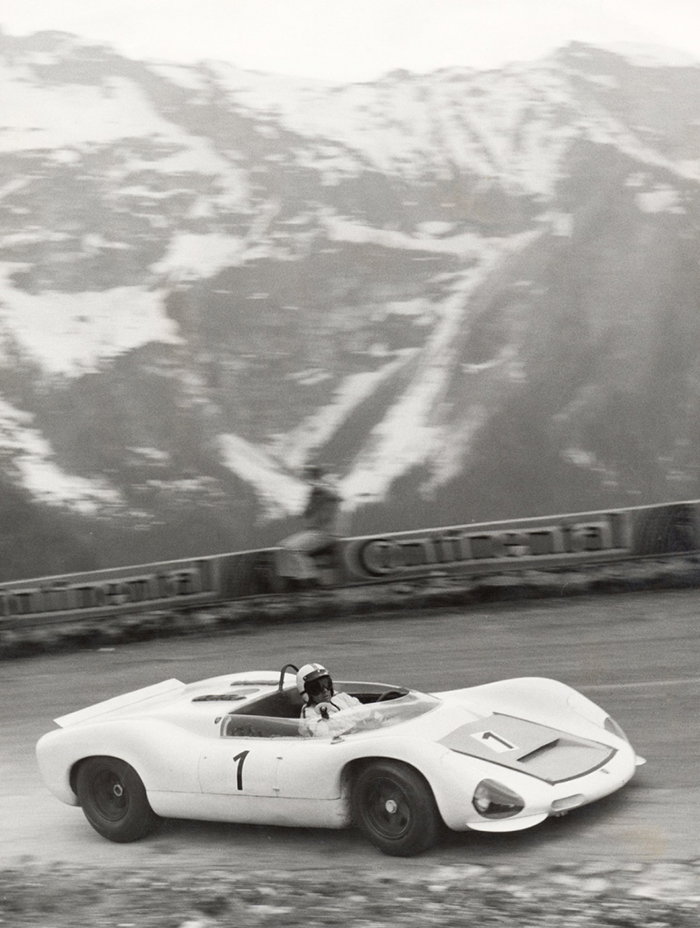
The 910 Bergspyder was designed to be lightweight at all costs, even if that meant that it was very difficult to handle.
Ferdinand Piech was never satisfied, and to him the 906 was a compromise, despite its incredibly successful career. One of the main reasons why he felt this way was of Ferry Porsche’s insistence that the leftover 904 suspension components should be used in the 906, much to Piech’s dislike. The 910 was the first project where he could truly do what he wanted, and he most certainly did. After a very successful 1967 World Championship season, four 910’s were built specifically for hillclimb competition. Three of these 910s received extremely thin fiberglass Spyder bodies, tiny 3.2 gallon fuel tanks (because you only needed fuel to go up the hill, not down it!), and rubber transaxle joints. The engine, the Type 771 flat-eight, was standard except that they lacked oil coolers for their dry sump systems. All this meant that the 904 Bergspyder weighed only 1,100 pounds, 220 pounds less than the standard 910. Their main opposition would be Alfa Romeo’s new T33, but it was not nearly as reliable as the 910.
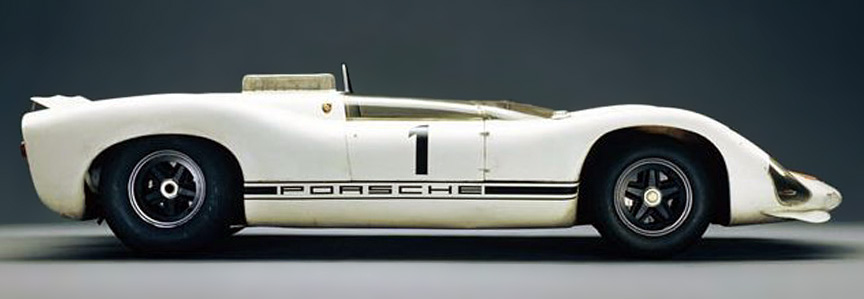
The only remaining 910 Bergspyder, Chassis 031, lives in the Porsche Museum collection. It is in entirely original condition (so original that it can’t start) and the Museum plans to keep it that way.
The first two events of the 1967 season were easily won by Porsche, finishing 1-2 at Montseny, and 1-3 at Berchtesgarden. By the third round of the season, Piech ordered his engineers to shave even more weight from the Bergspyder, as long as it didn’t cost more than $110 per pound. One car received beryllium brakes for $1000 per disc! The brakes were coated in chrome to prevent shedding dangerous beryllium dust. All of the 910 Bergspyders also received lightweight wheels. At Ollon Villars, Mitter drove a new 910 Bergspyder with an aluminum tubeframe, an even smaller fuel tank, titanium screws, and many new magnesium castings to save even more weight. This 910 Bergspyder, chassis 025, weighed only 925 pounds with fuel at the curb! This made 025 even more difficult to drive, as there was basically no weight on the front end, and major suspension adjustments were needed to keep the handling at least manageable. Fifty pounds of lead ballast were installed in 025’s front end to try to balance its weight distribution, with some success. 025 cornered at an extremely impressive 1.4 G at the Weissach skidpad. The rest of the season was a Porsche sweep, but it was a close battle between Stommelen and Mitter for the championship. Stommelen was given the reins to 025 for the last event to give him a real shot against Mitter. While Stommelen won that event, the championship went to Mitter on a tiebreaker (they both had four wins and two second places, so Mitter won because of his extra third place). But this unchallenged run wouldn’t last, as Ferrari announced they were building their own purpose-built hillclimb machine for 1968. This serious threat sent Piech to find the limit of just how light a car could be.
King Of The Hillclimbers
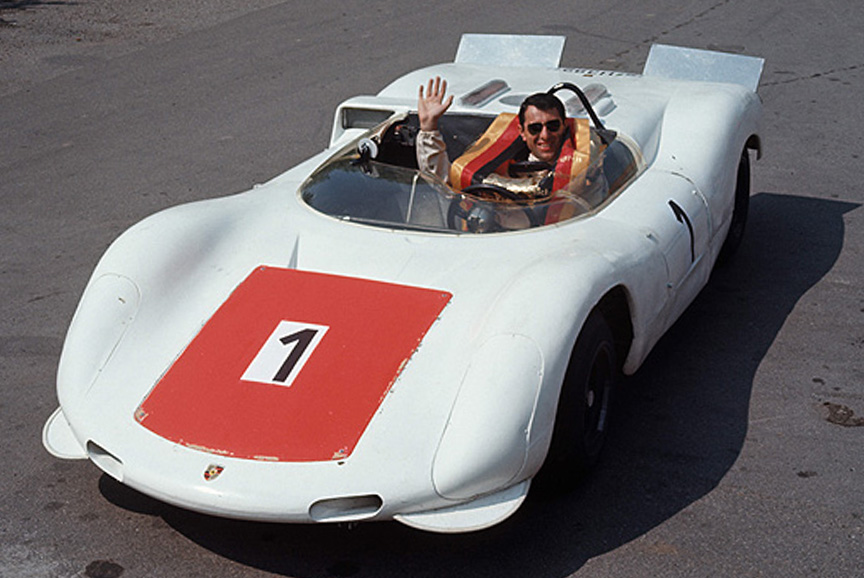
Gerhard Mitter in his 910 Bergspyder after winning the 1968 Rossfeld Hillclimb.
Three 910 Bergspyders were prepared for the 1968 season with several changes including upgraded front suspension, an antisway bar, and most importantly a pair of suspension-activated rear flaps. The flaps were intended to add downforce without reducing straight line speed. They were the predecessor to the active rear wings that would rein in the 908 longtails and the early 917s. Porsche also ditched the alternator, because the battery would last for one run without recharging. Ferry Porsche was concerned about how much Piech was spending on the racing program, and many of the expensive materials on the 910s were replaced with cheaper alloys. But all of that effort may not have been needed, as Ferrari’s car wasn’t ready for 1968, leaving Porsche without their biggest rival. Adding to Porsche’s already formidable lineup, Scarfiotti – the only driver who had managed to beat Porsche joined the team for the 1968 season. Meanwhile, Porsche’s engineers were fixing the 910 Bergspyder’s biggest problem – its unbalanced weight distribution. Their solution was to move the seating position forward until their feet were over the front axle, much to the drivers’ dislike.
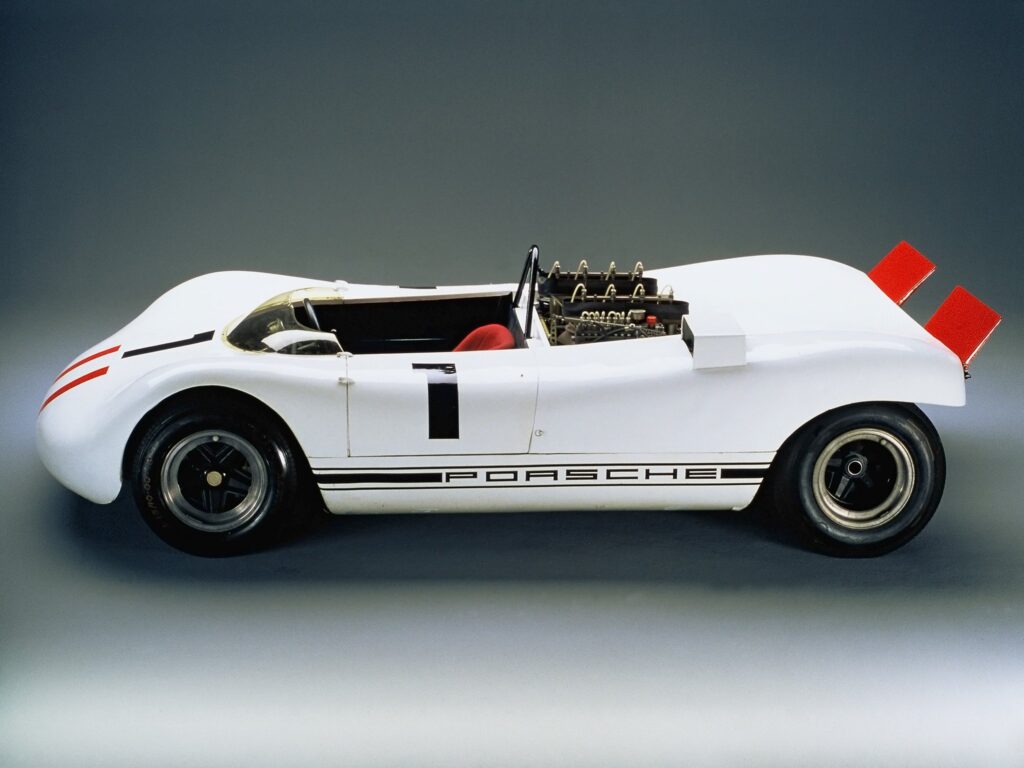
The 909 Bergspyder weighed a ridiculous 874 pounds dry, with a 275 horsepower flat-eight. This meant the 909 could do 0-60 MPH in 2.4 seconds in 1968!
This meant that a new car would have to be built, and it would be known as the 909 Bergspyder. Every single part of the 909 was as lightweight as it could possibly be. The tubes that made up the chassis were only one inch thick, which made them too weak to support even a bicycle. A fuel pump wasn’t light enough, so a unique pressurized fuel “tank” was used. It was basically a bag of fuel in a titanium case filled with nitrogen, which pushed the fuel out of the bag and into the engine. Piech reportedly went over the car with a magnet while it was being built and told his engineers to replace anything made from steel with lighter materials. The rollbar was as good as useless, being far too thin to give any real protection and not nearly tall enough. Even copper wiring was considered too heavy, and silver was used instead.
This is one of the only videos of the 909 Bergspyder in motion, at the Goodwood Festival Of Speed in 2019 after it was restored by the Porsche Museum.
In the end, the 909 weighed only 874 pounds dry, with 275 horsepower! But the 909 wasn’t ready for most of the 1968 season, so the 910 Bergspyders were raced. The first round of the 1968 season was an easy 1-2-3 for Mitter, Scarfiotti, and Rolf Stommelen. But the next race would be the darkest day of Porsche’s hillclimb program. In practice at Rossfeld, Scarfiotti inexplicably went straight off at a corner and crashed into the trees. Stommelen also broke his arm in a large crash just minutes earlier. Porsche was extremely defensive after Scarfiotti’s crash, as some suggested that something had failed on his car. The reason why Scarfiotti crashed has never been explained, as an investigation into his wrecked 910 Bergspyder found no signs of failure. Scarfiotti was the first Porsche factory driver to die at the wheel, only a few months after he joined their team. Stommelen was also injured in a large crash just minutes earlier. Mitter won convincingly anyway, and the season continued despite the tragedy. When the 909 was finished, it was still difficult to drive, and more dangerous than the 910, thanks to the driver’s feet being the crumple zone. The drivers had mixed reactions to the 909, with Mitter calling it “the best car we’ve ever had” when he drove it for the first time, but then decided he would be faster in the old 910. Stommelen was willing to race it, but he gave the very contradictory statement of “The new one inspires confidence in me, although it feels more lethal at high speeds.” Stommelen drove the 909 in only two hillclimbs, where he finished second behind Mitter’s 910 Bergspyder. Mitter won seven out of eight events in his 910 Bergspyder, easily winning his third and final Hillclimb championship.
Ferrari’s (Late) Answer
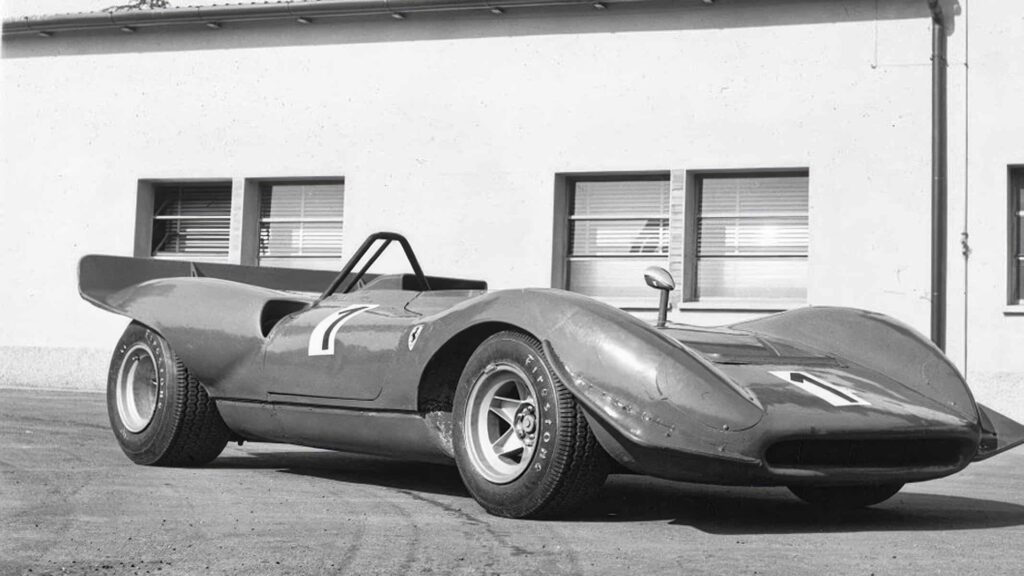
The 212 E Montagna outside of the Ferrari factory. This was Ferrari’s first flat-twelve powered prototype, before the all-conquering 312 PB used a similar layout.
Sadly, the direct matchup between Ferrari and Porsche’s purpose-built hillclimb cars never happened, but Ferrari’s new car was every bit as capable as Porsche would have feared. Originally known as the Sport 2000 Montagna, it was later renamed as the 212 E Montagna (Mountain). Mauro Forghieri was in charge of the project, as usual for Ferrari racecar of this era. The new car was based on a Dino 206 S chassis, but powered by a 2.0-liter flat-twelve with its roots in the 1964/65 Tipo 232 F1 engine. It made 300 horsepower at a screaming 11,800 rpm. The Dino 206 S chassis that the 212 E was built on was actually used for a Pininfarina-designed concept car known as the 250 P5. After the Turin Motorshow in 1968, it was sent back to Ferrari, where they removed the body and began building the 212 E. Its dry weight was 1,102 pounds, significantly heavier than the Porsches that it was supposed to race against, and combined with an ultra-thin fiberglass body that was three inches shorter and eleven inches wider than the 206 S, the 212 E just needed a proper driver to start destroying course records.
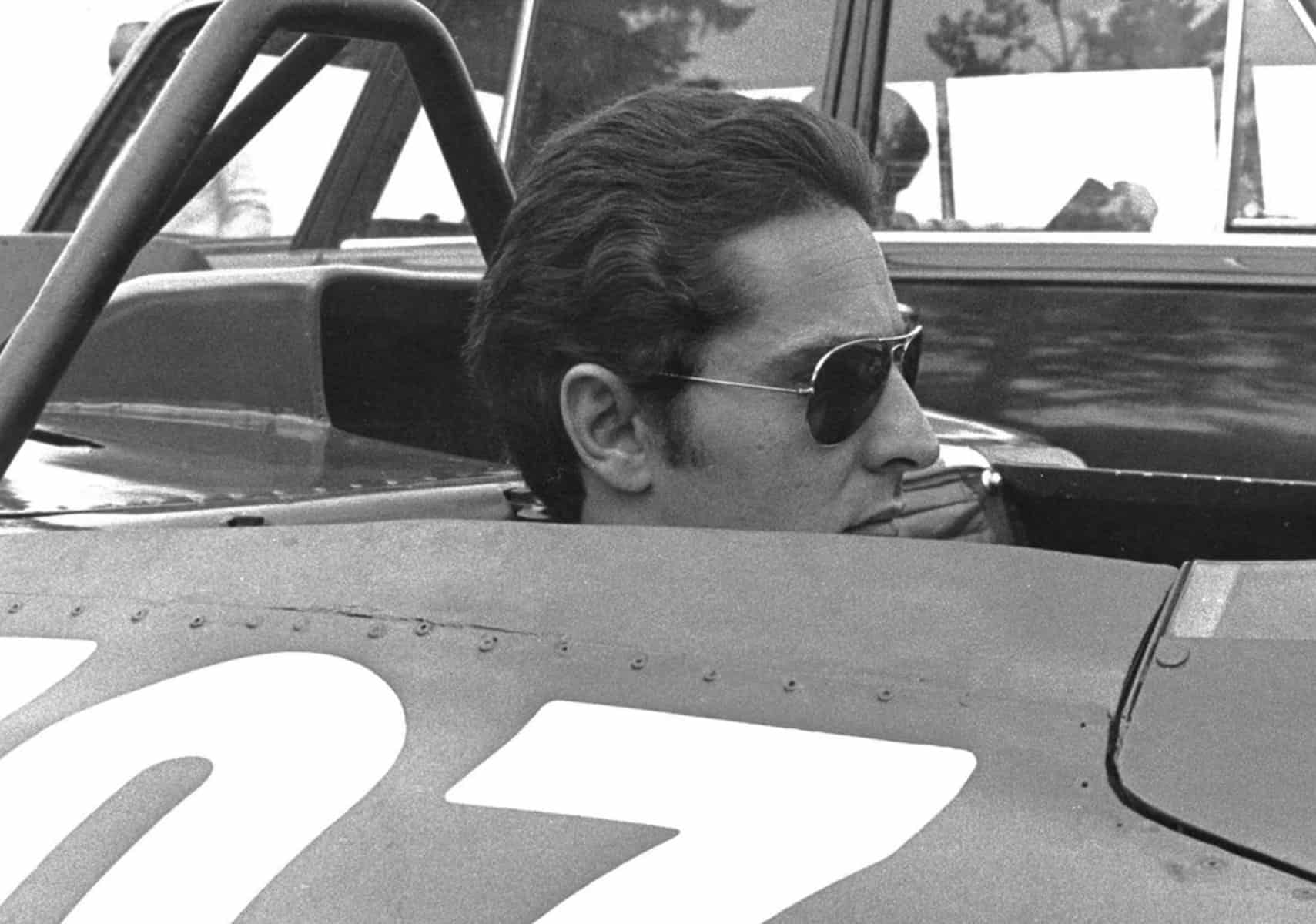
Peter Schetty sits in the 212 E Montagna at the 1969 Freiburg-Schauinsland Hillclimb. Schetty later drove for the works Ferrari team in 1970 and then managed the team until 1973.
Ferrari found that driver in Peter Schetty, a wealthy Swiss who had achieved solid results in the European Hillclimb Championship before, in a Shelby GT350 of all cars. Schetty helped develop and test the 212 E as part of his contract, so no one knew it better than he did. Abarth was Ferrari’s main rival, with their new 2000 Sport Spider and a solid lineup of drivers, including Arturo Merzario. The Ferrari team was made up of only one mechanic and three engineers, but that wasn’t an issue as the 212 E proved to be quite reliable. It crushed the opposition, winning the first few events by over 20 seconds, although Abarth did get closer to the Ferrari’s speed by the end of the season. The rest of the season saw the 212 E and Schetty win all but the last event, which was skipped as they had already sealed the championship. Ferrari decided that one season was enough and left hillclimbing for good as a Works team. The 212 E was sold to a privateer team, and the flat-twelve was used in a new chassis with a new body, and Edoardo Lualdi-Gabardi drove it for a few hillclimbs in 1971. Neither Porsche nor Ferrari would ever return as a Works team to hillclimbing.
If you’re wondering what that 11,800 rpm 2.0-liter flat-twelve sounds like, this video is your answer.
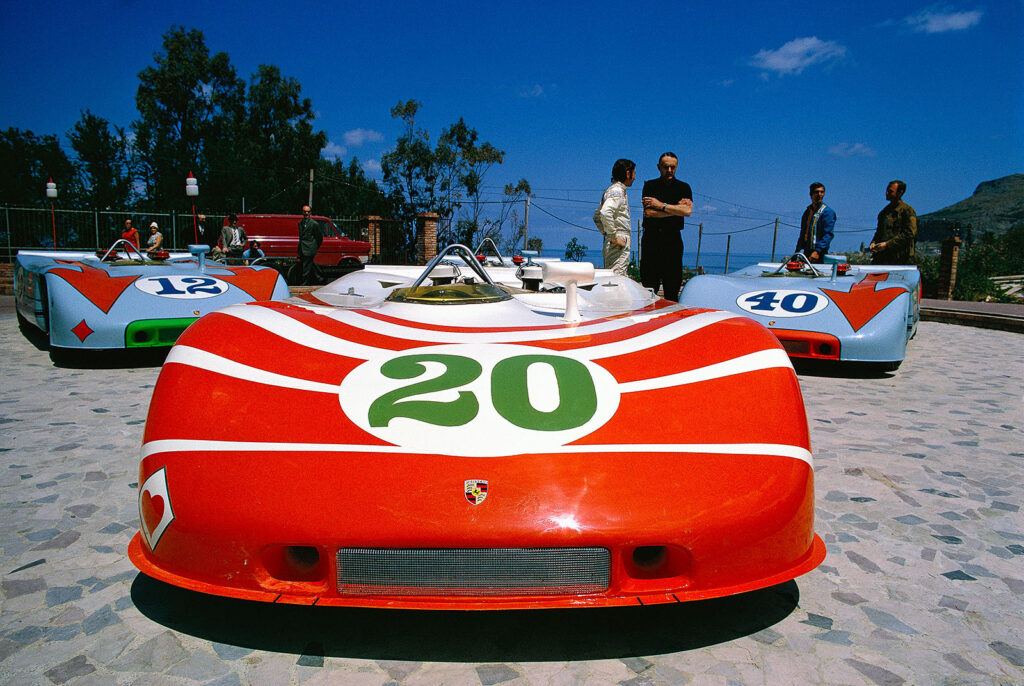
When Porsche designed the 908/3 for the tight Nurburgring and Targa Florio, they used the 909’s driver position and many other learnings from the Bergspyders.
Porsche and Ferrari’s occasional rivalry in the hillclimb championship would soon be completely overshadowed by the 917 versus 512 battle in the history books. But both manufacturers learned from their hillclimb programs, especially Porsche, which used many of the Bergspyder’s innovations for the 908, 908/3, and even the 917. Gerhard Mitter worked hard to get into F1 and was set to race for Ford in 1970. But tragically, he died in an F2 race at the Nurburgring in August 1969. Peter Schetty’s career with Ferrari also continued successfully, as he was called up to drive the 512 S for the works Ferrari team in 1970. Enzo soon realized Schetty’s talent as a manager and not just a driver, and made him the head of Ferrari’s sportscar program until 1973, when he went back to his family’s business. While works teams are nonexistent in hillclimbing now, it’s interesting to imagine what Porsche and Ferrari would have built if they continued.
Photo Credits: Cover: unknown 718 W-RS: unknown 196 SP: unknown 166 SP: 904 Bergspyder: unknown 206 S: unknown 906: unknown 910 Bergspyder: unknown, Porsche, unknown 909 Bergspyder: Porsche 212 E: unknown, Egon Hofer unknown 908/3: Rainer W. Schlegelmilch
