It’s time for another installment of the series where I feature some of my favorite classic car photos and explain what makes them great. This time, we’re taking a look at the work of the great French photographer Bernard Cahier.
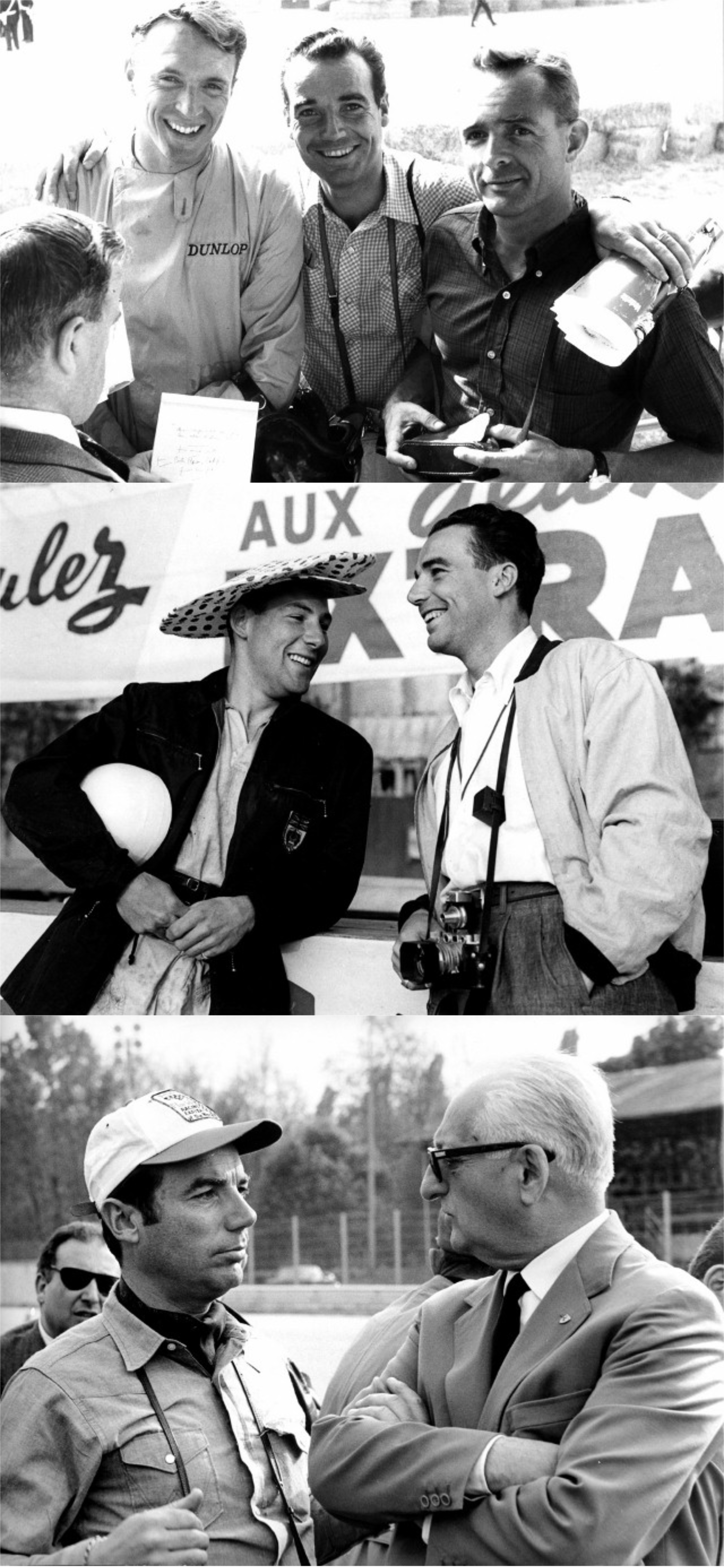
Bernard with Phil Hill and Dan Gurney (ltop), Stirling Moss (center), and Enzo Ferrari (bottom). For a photographer, he appeared in front of the camera far more than you might expect.
Bernard photographed racing for over 30 years, but his photos from the 50s and 60s are the standouts. Born in France in 1927, he fought for the French Resistance and the 2nd Tank Division in WWII. He then went to college in California, where he met many people in the thriving American racing scene, as well as his future wife, Joan. He returned to Europe in 1952 and, later that year, traveled to Monza with a camera, an experience that began a long career in photography. Bernard also wrote for several magazines, including Road & Track and Sports Car Graphic. But his standout ability was making friends. He knew almost everyone in the paddock, from friendly faces like Stirling Moss and Phil Hill to intimidating figures like Enzo Ferrari.
Bernard was a talented driver too, winning the GT class in a Porsche 911 with Olympic gold medalist Jean-Claude Killy at the 1967 Targa Florio. Bernard also helped John Frankenheimer work with a skeptical F1 paddock during the production of Grand Prix. It was a great time to be a journalist or photographer. The circuits were beautiful, and the paddock was far less corporate than today. The lack of fences and restrictions, although very dangerous, resulted in some incredible images. Many well-known writers of the time, including Bernard, Denise McCluggage, and Denis Jenkinson, also raced as a hobby. Bernard retired in the 80s, but he still traveled to races all over the world. His son Jean-Denis continued to photograph the Grand Prix circuit. Bernard passed away in 2008. These photos are only a glimpse of the incredible number he shot, but they are some of his best. I’ve focused on cars in action in this article, but Bernard was great at capturing people, too.
REIMS, FRANCE – 1964
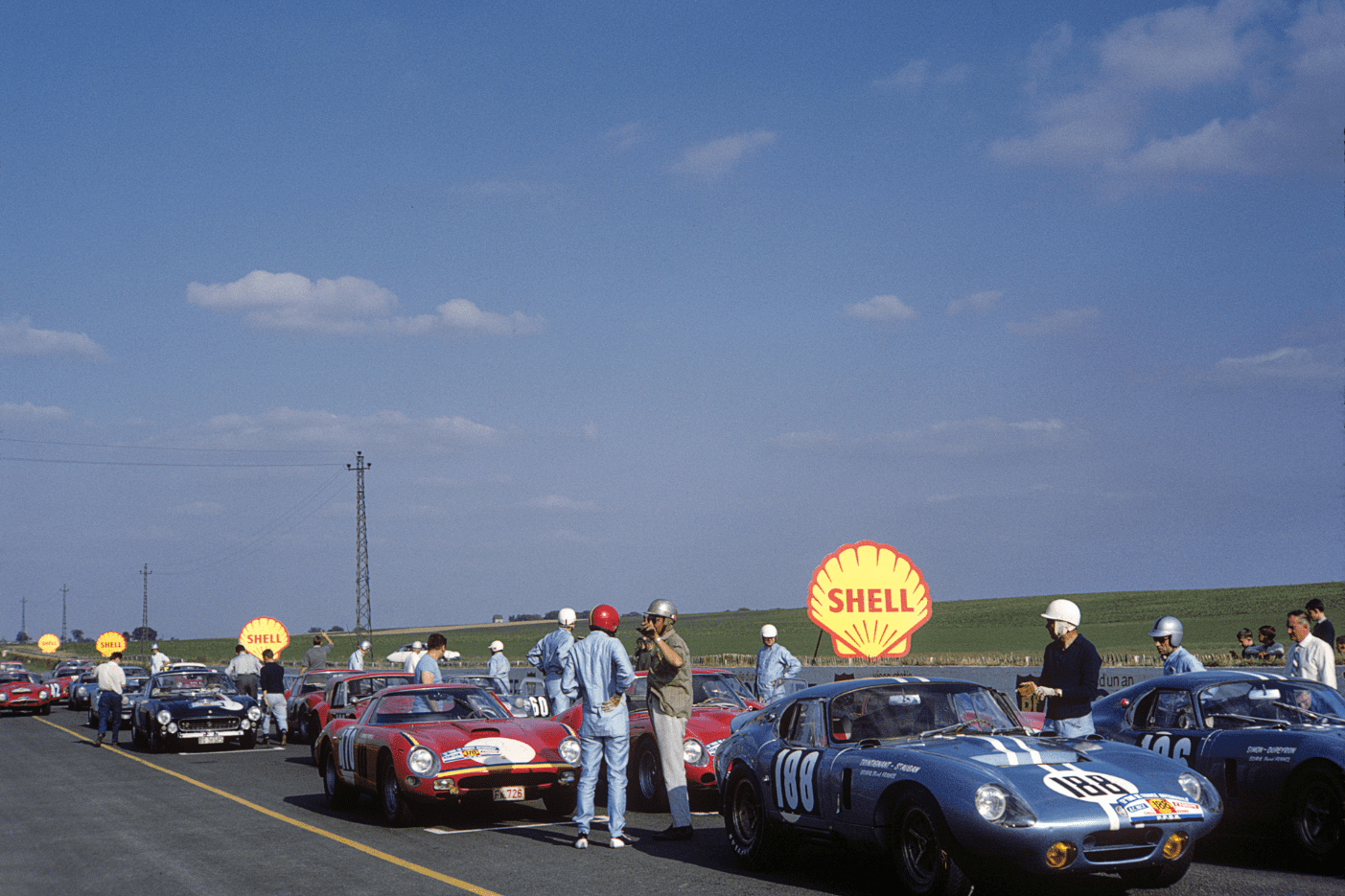
Drivers and their cars wait on the starting grid at Reims during the 1964 Tour de France Automobile.
The Tour was a 10-day endurance test around France, stopping for races and hillclimbs along the way. It was an epic event, where dozens of the newest GT and Touring cars were raced by top drivers. Ferrari had absolutely dominated the Tour in the 50s and 60s, winning nine straight. In 1964, Ferrari and Shelby were competing for the World Championship for GT cars, with the iconic 250 GTO and Daytona Cobra.
The Daytonas were faster at almost every stage, but the GTO’s reliability and Ferrari’s experience won out in the end. This photo was taken on the grid at Reims, before the start of the GT race (the Touring cars raced separately). Jochen Neerpasch dominated the 90-minute race in his Daytona. The grid is stacked with some of the greatest GT cars ever, while a blue sky and endless fields add to this photo’s charm. Shelby Cobras, Ferrari GTOs, Lussos, Porsche 904s, and an Alfa Romeo TZ.
RIVERSIDE, CALIFORNIA – 1969
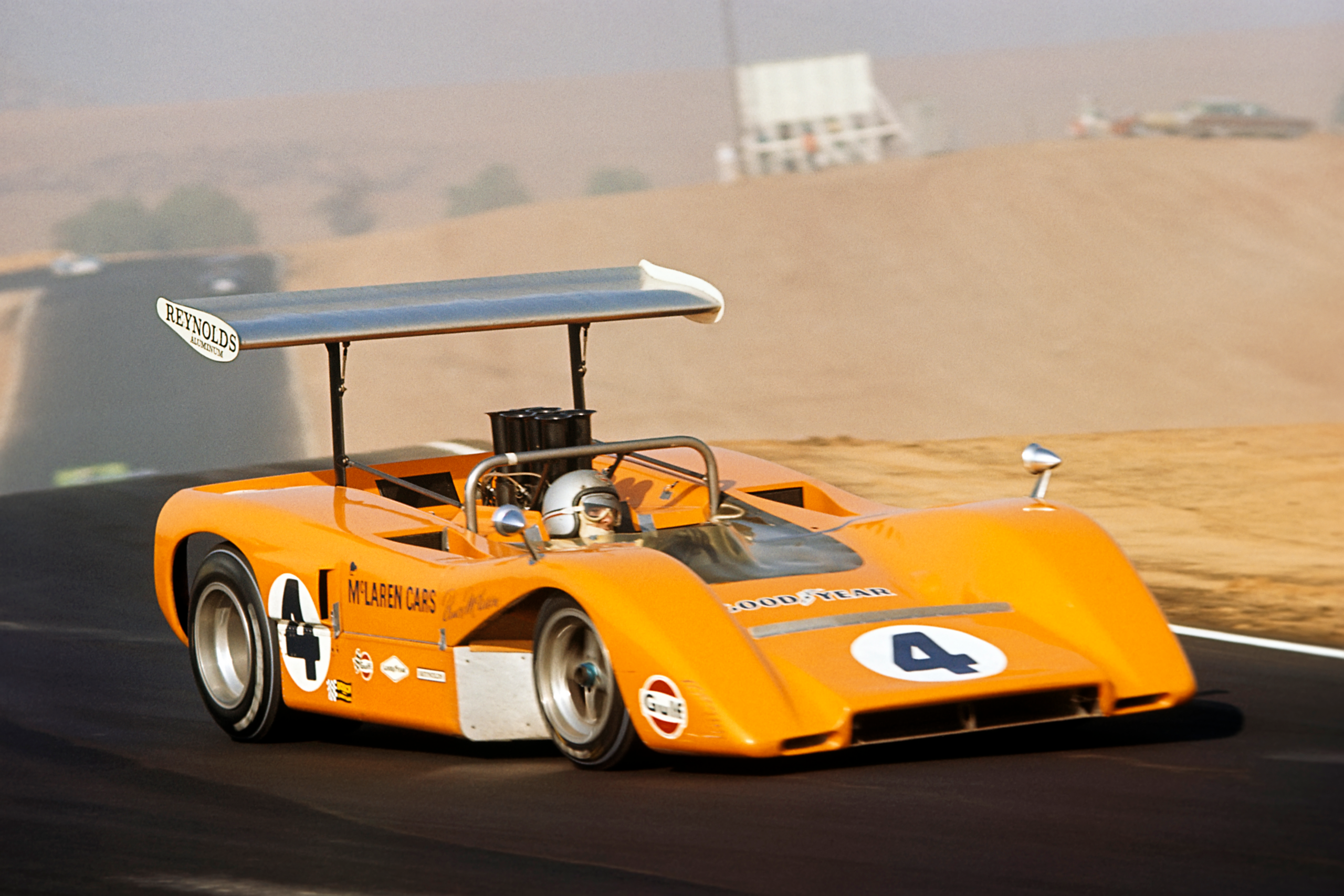
Bruce McLaren hustles his McLaren M8B around Riverside Raceway during the final round of the Can-Am championship.
He didn’t finish this race, but it was an amazing weekend for him nonetheless, as he won his second Can-Am title. Bruce and Denny Hulme won 11 out of 11 races in 1969, the most dominant of several seasons of “The Bruce and Denny Show”. The M8B’s standout feature was its massive suspension-mounted rear wing. It was the high point of McLaren’s success so far. Tragically, Bruce would die in a crash before the start of the 1970 season, never seeing what his team would achieve in the future. In this shot, the M8B takes up most of the frame. It’s hard not to smile at such an outrageous car, with its cartoonishly huge wing and iconic papaya-orange paint. It totally stands out against the barren Riverside backdrop.
MONTE CARLO, MONACO – 1956
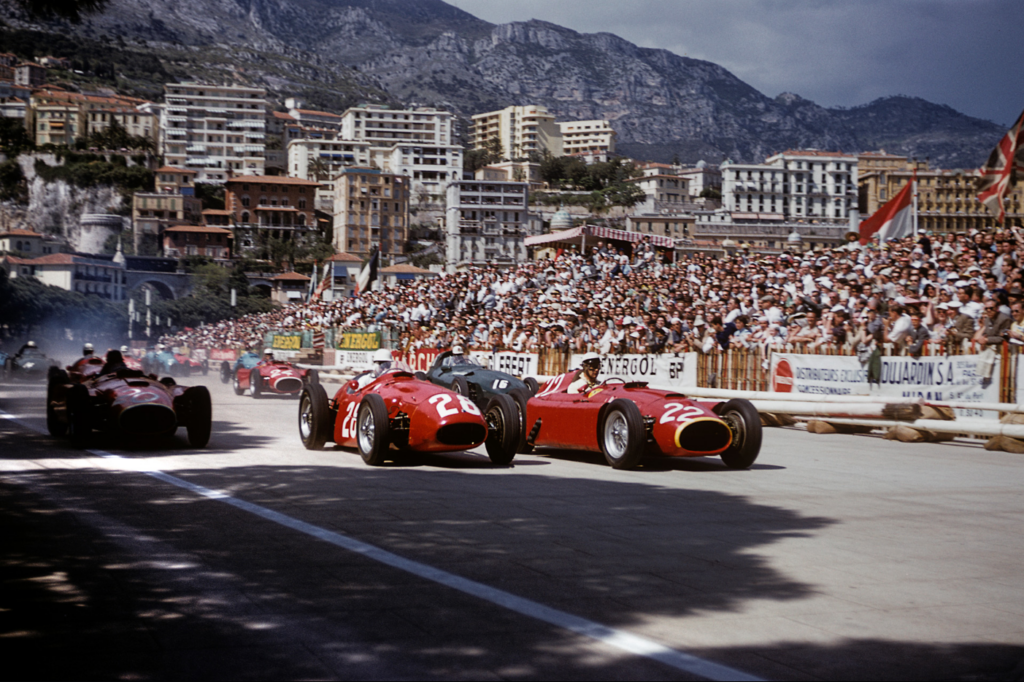
Juan Manuel Fangio barely leads the start of the Monaco GP in his Ferrari-Lancia D50, ahead of his friend and rival Stirling Moss in his Maserati 250F.
Moss would take the lead into the first turn and was five seconds ahead by the end of the first lap. Fangio spun his car soon after, taking out another D50 and a Vanwall. He drove back to third place until he hit a wall and handed his car to teammate Luigi Castelotti, whose car had broken down.
Peter Collins was driving the remaining D50, but Fangio was number one at Ferrari, so a frustrated Collins handed over his car, and the Maestro was back at it again. Fangio charged back through the field, eventually finishing second behind Moss, who had finally beaten his mentor. But Fangio had redeemed himself after an uncharacteristically sloppy drive. This shot sums up the Monaco GP in one frame. It’s so immersive that it feels like you could just walk into it.
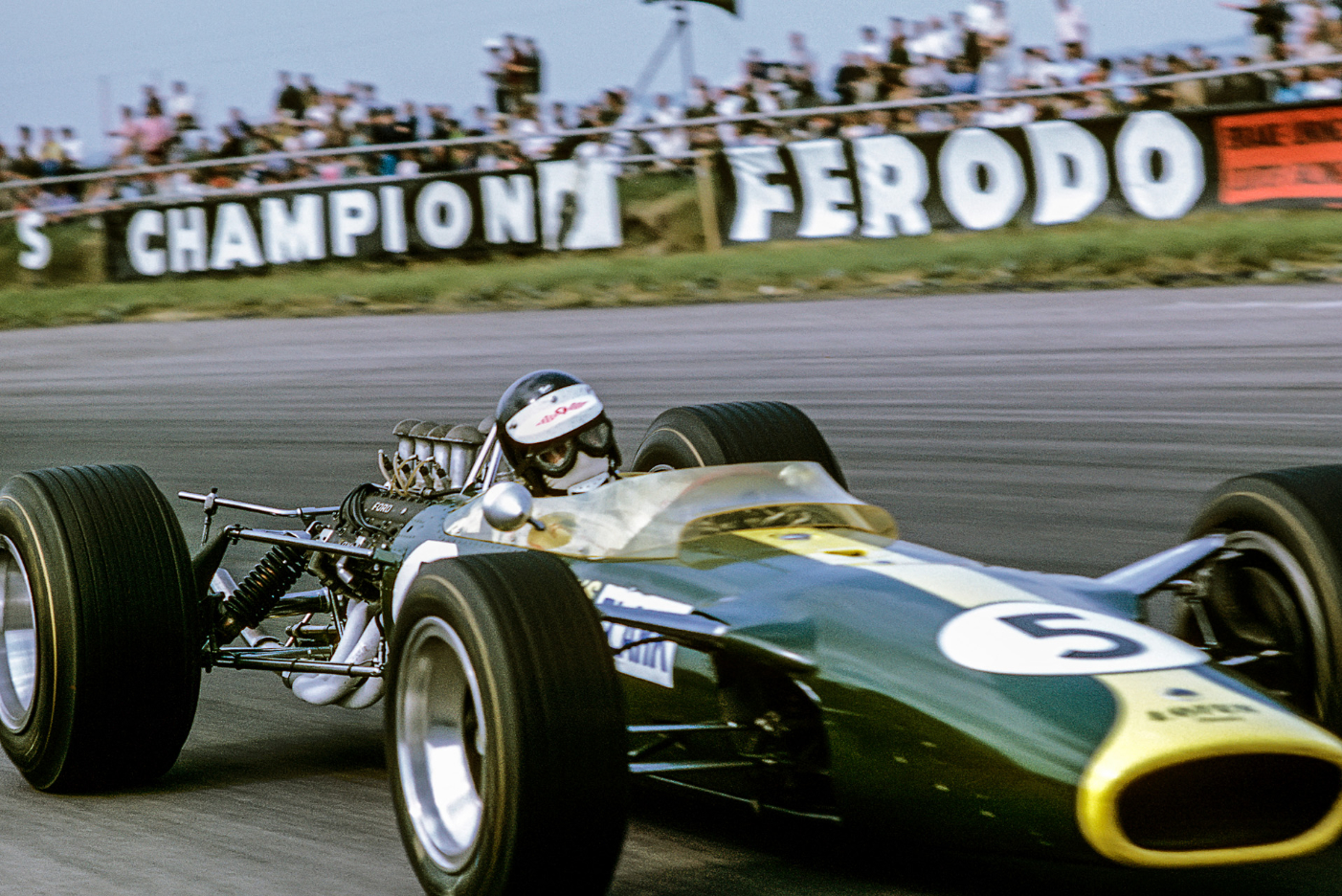
ZANDVOORT, THE NETHERLANDS – 1967
Jim Clark drives the Lotus 49 in its competition debut, the Dutch Grand Prix.
The 49 was one of the first race cars to use its engine as a stressed, load-bearing member of the chassis. The 49 was the first car to use the legendary Ford-Cosworth DFV V8, which went on to win 13 F1 championships, 2 Le Mans 24 Hours, and 10 straight Indy 500s. Graham Hill had spent far more time testing the 49, qualifying on pole, while Jim Clark only managed ninth.
But Hill’s 49 broke, and Clark drove through the field to the win. This shot captures the sense of speed as the car charges through the frame. This angle is unique and offers a good look at the contrast between the cigar-like front end and the exposed, spindly assembly of engine, chassis, and suspension at the rear. It’s an atypical shot and an example that you don’t need the whole car in frame for a great photo.
SICILY, ITALY – 1955
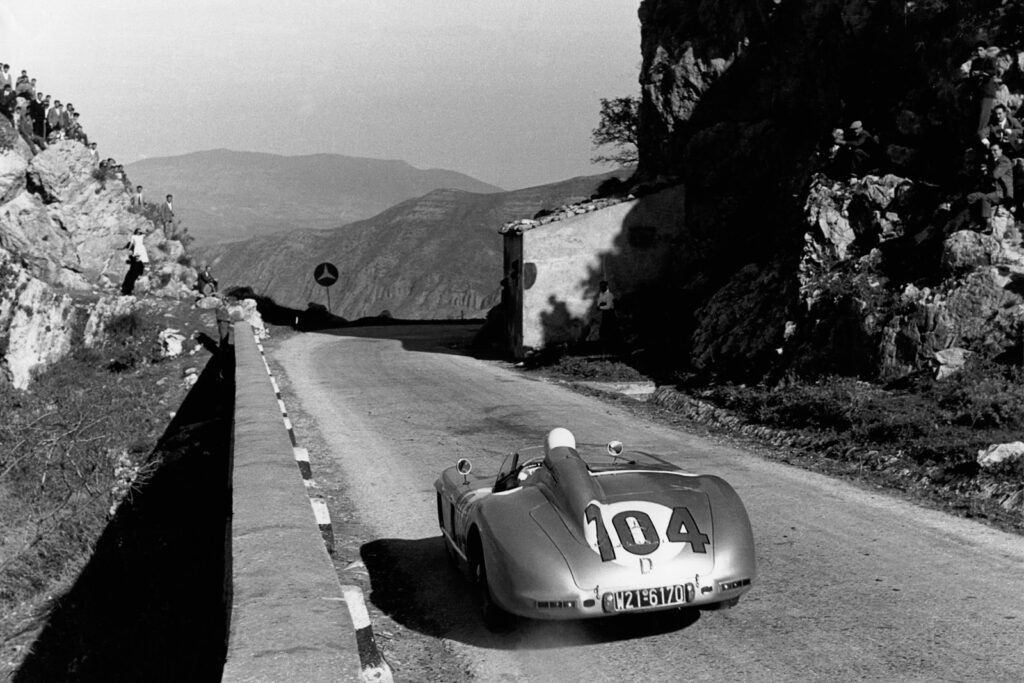
Stirling Moss charges through the Sicilian mountains in his Mercedes 300SLR.
The Targa Florio was the final race of the World Sportscar season, and Mercedes was fighting Ferrari for the championship. Stirling Moss was paired with Peter Collins in the #104 300SLR. Moss blasted off at the start and easily led until he lost control and slid off the road, landing about ten feet below. Spectators rushed to help him and pushed his car back on the road.
Moss arrived in the pits 12 minutes later than expected with a damaged car. Collins got in and drove the race of his career and won, with another 300SLR finishing second. Mercedes had won the WSC and F1 Championships. But Mercedes would quit racing due to the Le Mans disaster, and they wouldn’t return for over 20 years. This shot captures Moss before the crash. Dozens of spectators watch from the cliffs. You had to take any spot you could get at the Targa. I love the framing on this photo, the way the road curves before disappearing behind a wall, and the mountains in the background.