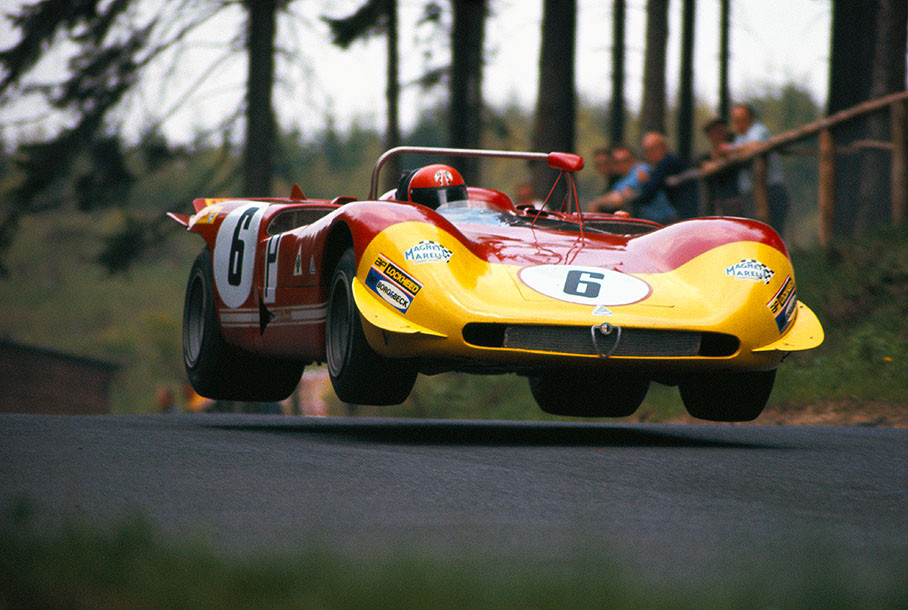
An Alfa Romeo 33/3 in the air at the 1969 Nurburgring 1000KM.
The Alfa Romeo Tipo 33s were some of the prettiest racing cars ever made and stood out even in an era when most race cars were beautiful. For Alfa Romeo, “33” was the name given to their sports prototypes from 1967 to 1977. All of Alfa Romeo’s factory racing efforts in this era were carried out by Autodelta, run by the headstrong Carlo Chiti, a former head engineer at Ferrari. Autodelta’s most famous early projects were the gorgeous TZ and TZ2 GT racers, but it also ran Alfa’s F1 effort and built many production-based racers, such as the GTA. While the 33s were more often than not outcompeted by their highly experienced rivals at Porsche, Ferrari, and Matra, they still captured some major wins and championships. And no other cars looked better doing it. Here are all seven 33s, along with their history, specs, and key results. Much of the information in this article comes from the Autodelta Golden Years website, and if you want to learn more about these cars, it’s a must-read.
1967 Tipo 33 “Fleron”
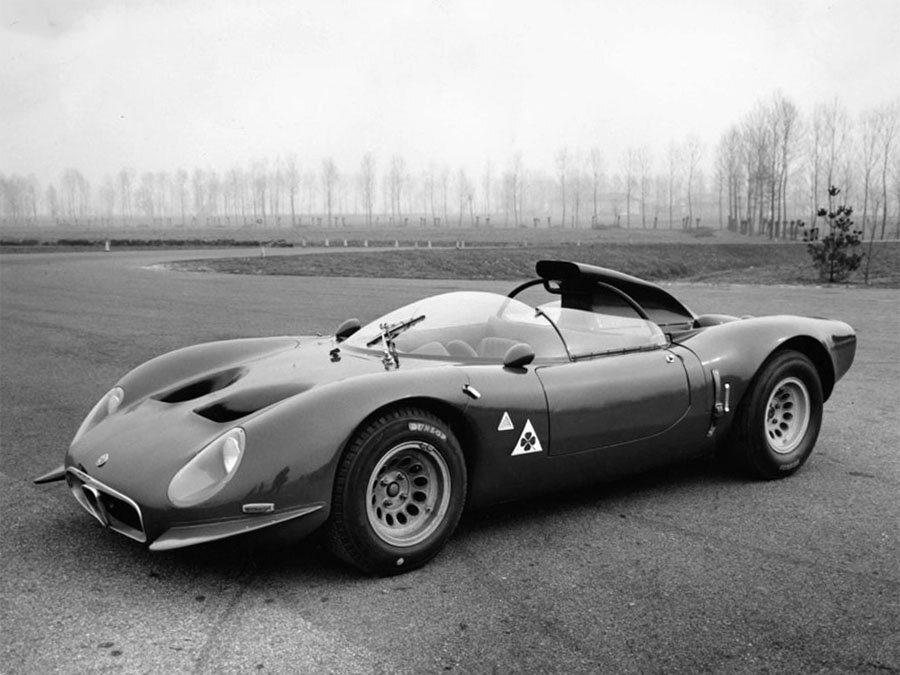
The “Fleron” still has perfect proportions today, but unfortunately, it didn’t live up to expectations on the track.
The idea of a tube-frame mid-engine prototype racer originated with Alfa Romeo’s Servizio Esperienze Speciali division in 1964. The project was known under the internal code “105.33”. It was expected that the project would take about two years to develop. When Carlo Chiti joined Alfa, he claimed that the car’s development would take only months rather than years. This started tension between Autodelta and the Speciali division, which would last for a long time. The 33’s most distinctive design element was an H-shaped chassis frame that used the 7-inch-wide tubes on each side as fuel tanks to ensure equal weight distribution. A new transmission was developed for the 33, and the suspension used double wishbones at the front and lower wishbones and twin trailing arms at the rear. The first 4-cylinder-powered prototype was not very good, with handling problems and frequent overheating. Chiti proposed several different body designs, but the engine was where the biggest improvements would be made. A V12 was considered, but the idea was scrapped in favor of a lighter V8. The 2.0 Liter V8 was not entirely new, though it is debated whether it was a design Chiti had previously worked on at Ferrari or was under development at Alfa Romeo when he took over the 33 project. The dual-cam, fuel-injected V8 made a very potent 260 horsepower at 9,600 RPM, more than enough for a car that weighed less than 1,300 pounds. The 33 took over two years to develop, despite Chiti’s predictions.
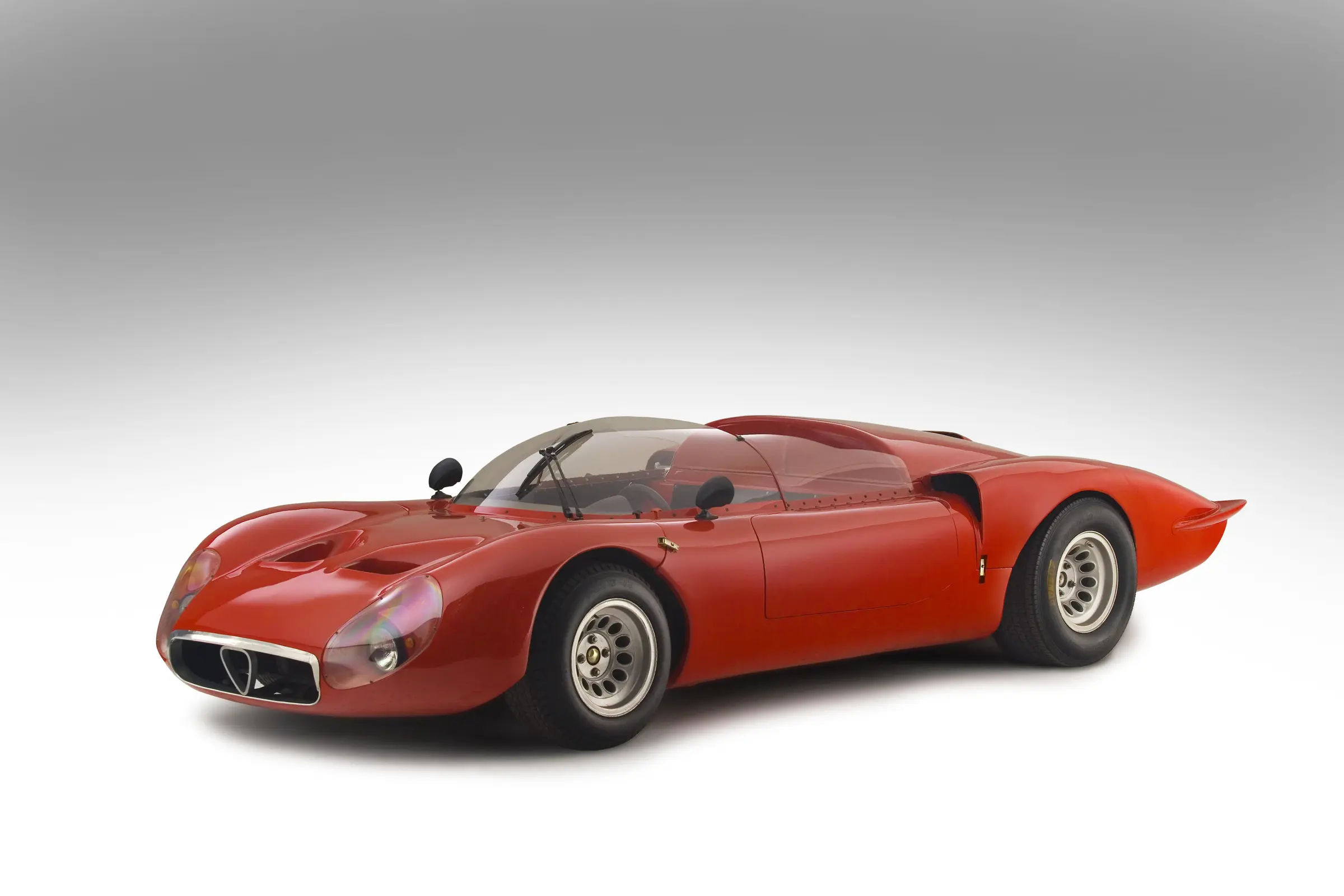
The long-tail T33 never got a chance to compete at Le Mans because Autodelta was concerned that the powertrain and suspension weren’t prepared for a 24-hour race.
Nicknamed the “periscopio” by the press for its roof-mounted intake, the 33 debuted at the 1967 Fleron hillclimb in Belgium, where it won easily, though it faced little serious competition. The 33 would enter several races of the 1967 World Sportscar Championship, with Porsche as their main rival. It was a tough season with DNFs at the Targa Florio, Sebring, and Mugello, but the 33 showed its pace and won several hillclimbs, although it couldn’t keep up with Porsche’s radical 909 Bergspyder. A long-tail version was tested at Le Mans, but Autodelta skipped the race as they felt that the car wasn’t developed enough to last 24 hours. Autodelta decided that the T33 would require significant development, resulting in a new car for 1968.
Specs: 2.0 Liter V8, 260 horsepower, 170 MPH top speed, 1,278 pounds weight
1967 33 Stradale
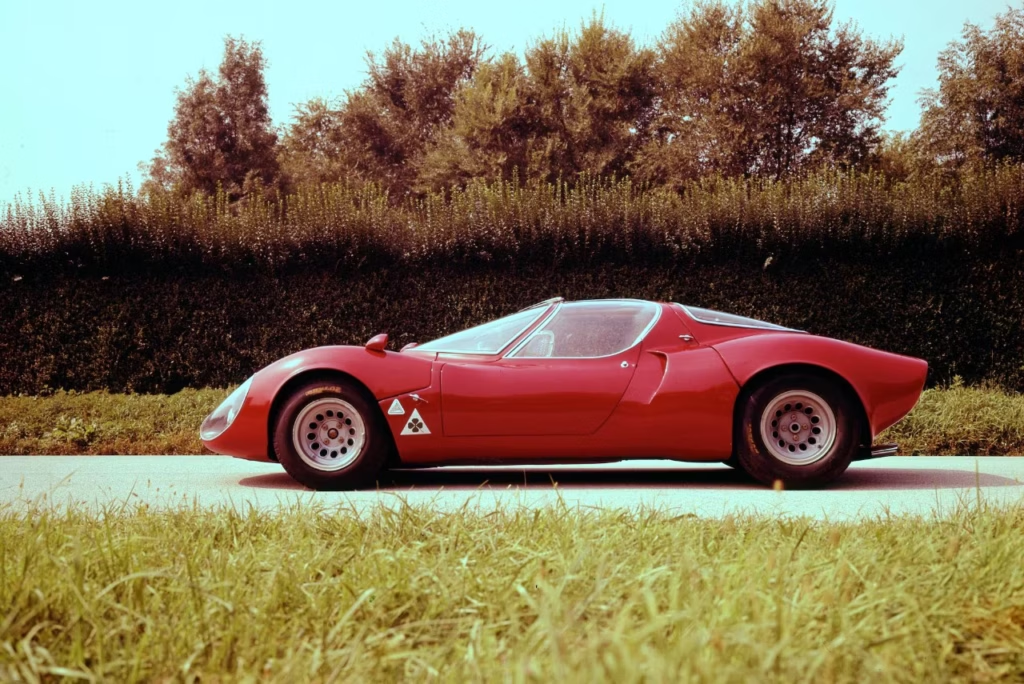
Ask a car enthusiast what the most beautiful car ever built is, and the 33 Stradale will be a common answer.
In 1967, the president of Alfa Romeo, Giuseppe Luraghi, decided to build a road-legal version of the 33 as a “dream car”. While the supercar genre didn’t yet exist, the 33 Stradale (meaning “road-going”) would have fit that definition very well. The 33 Stradale’s frame was similar to the racecar’s, but with steel tubes and magnesium subframes to improve its suboptimal rigidity. For the road car’s body, Alfa Romeo turned to Franco Scaglione, who designed the Giulietta Sprint, the B.A.T concept cars, and the Porsche 356 Abarth GTL, among others. The finished 33 Stradale was easily the most beautiful road car of its time, and it performed as well as it looked. The V8 was detuned to 230 horsepower at 8,800 RPM, but it still could do well over 160 miles an hour. As the 33 Stradale still had a very small interior, Scaglione designed butterfly doors, another supercar feature that added to its otherworldly design. Each 33 Stradale was slightly different as the bodies were handmade by Marazzi. The interior of each 33 Stradale was tailored to the customer’s preferences, with some cars featuring leather or fabric. The 33 Stradale cost nearly 10 million Italian lire new, making it far more expensive than any other production sports car at the time. Eighteen 33 Stradale were built, and all of them were sold.
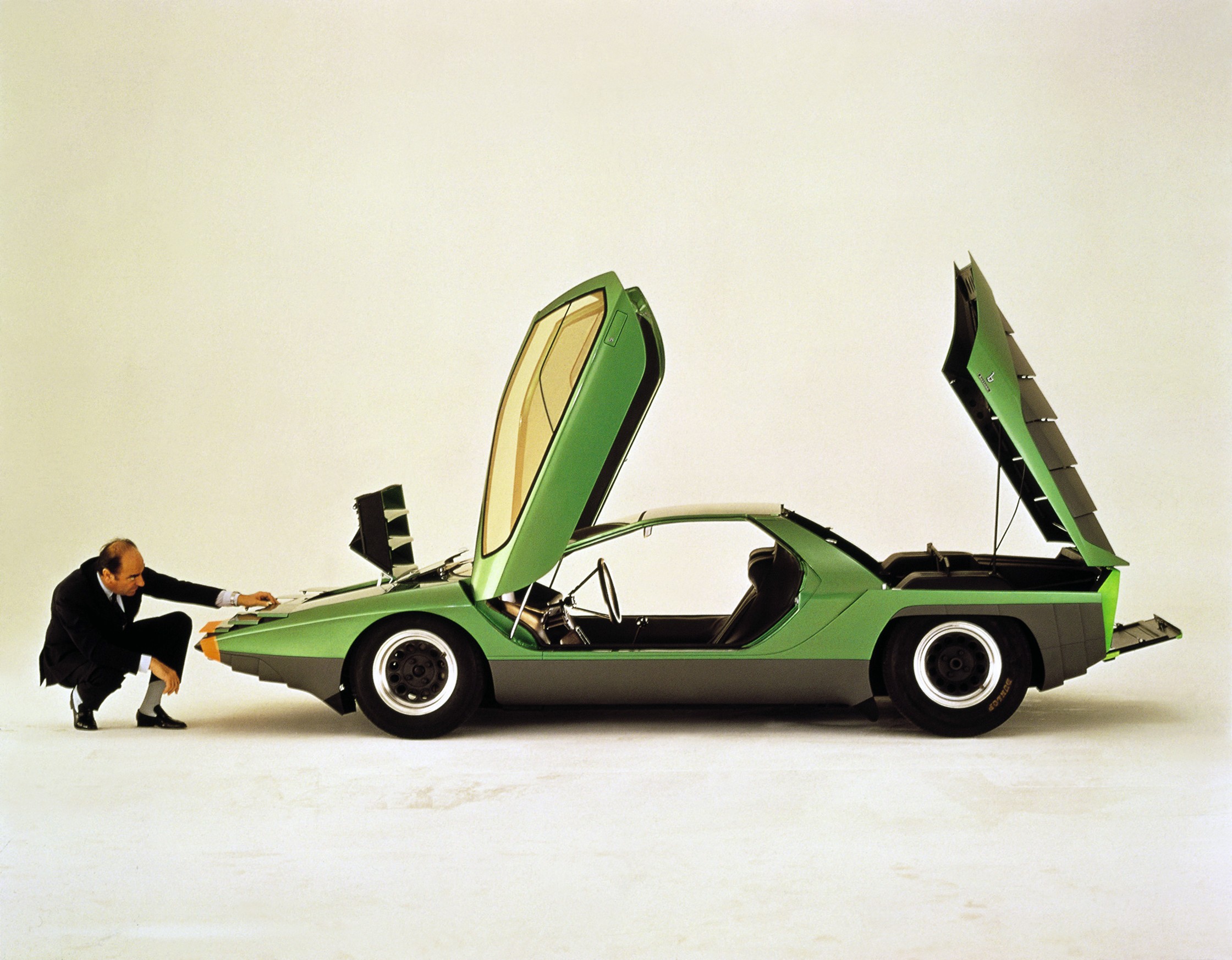
The 33 Stradale-based Bertone Carabo is one of the most iconic concept cars ever.
All 33 Stradales were red, except for a blue car built for Count Giovanni Agusta, which also had helicopter seats from his aviation company. Two 33 Stradale were raced in hillclimbs by their owners in Italy. Five unused chassis were sent to Italian coachbuilders and used as the basis for several iconic concept cars, including the Bertone Carabo, the Italdesign Iguana, and the Pininfarina P33 Spider.
Specs: 2.0 Liter V8, 230 horsepower, 160 MPH top speed, 1,543 pounds wet weight
1968 Tipo T33/2 Daytona
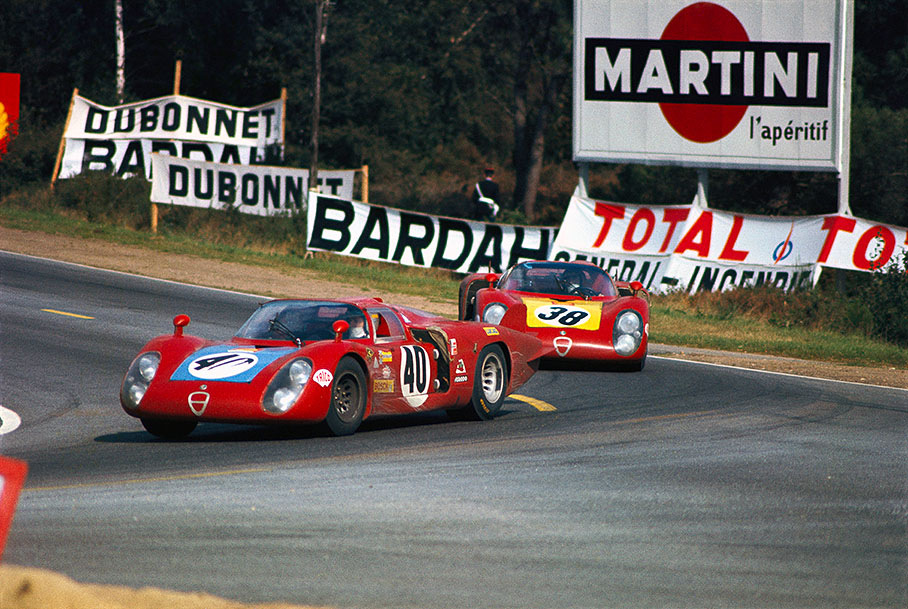
While the 33’s competition career got off to a dismal start in 1967, the Tipo 33/2 more than redeemed it with a very successful 1968 season.
Fixing the many issues of the original Tipo 33 resulted in an upgraded car for 1968, and new, equally pretty bodywork was the biggest change. The body had many improvements over the previous 33, including a new tail and a lower side profile to reduce lift. The “periscope” roof intake was also removed to reduce lift. The resulting car, the Tipo 33/2, was probably the car Alfa Romeo had hoped for when the 33 project was planned. The 1968 Daytona 24 Hours was the first race of the year, but Alfa was now forced to enter the 3-liter class, as the old over- or under-2-liter classes were gone. Porsche took an easy 1-2-3 finish with their long-tail 907, but the 33/2’s finished 5th, 6th, and 7th after the 907s and a Shelby Mustang, which was good enough for the 33/2 to be nicknamed “Daytona” by the team.
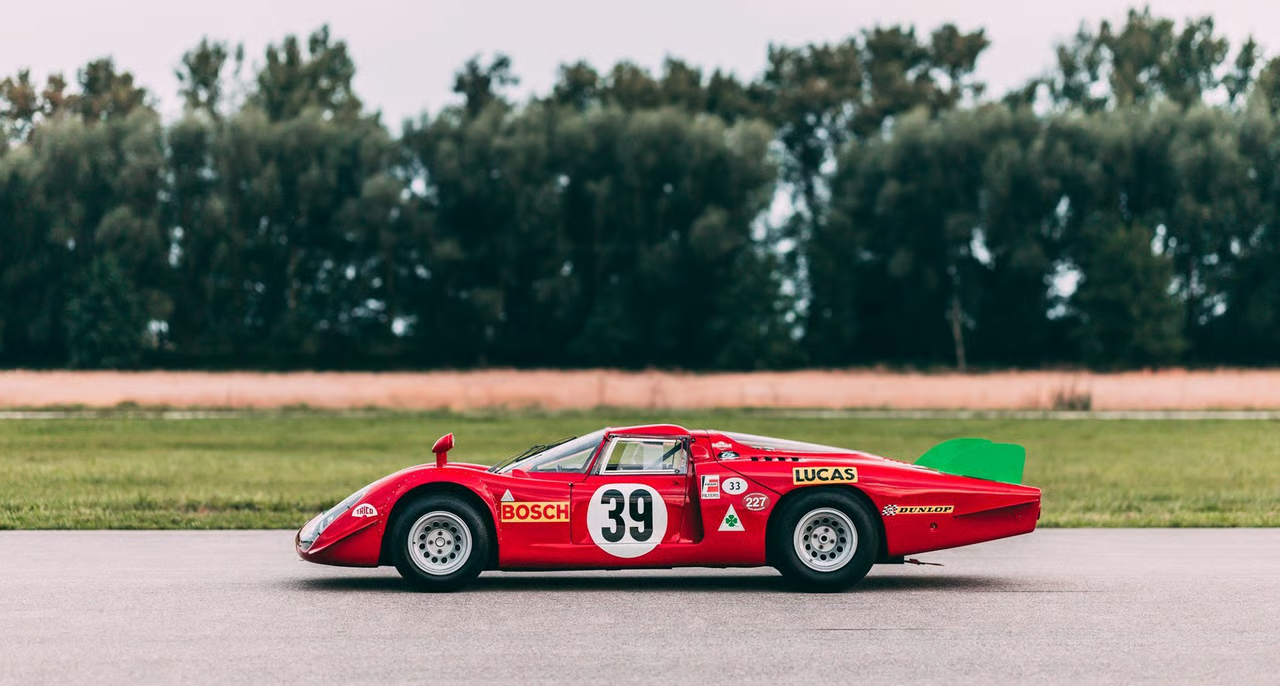
The longtail was a trick straight out of Porsche’s book, and it worked very well, as three Tipo 33/2s finished 1-2-3 in the under-2-liter class at Le Mans.
An upgraded 2.5-liter, 315-horsepower engine was introduced for select races. While Autodelta entered major endurance races and the Targa Florio, most of the races were contested by privateer teams. The next few races had mixed results, with DNF’s at Brands Hatch and Monza, but there was a class win at the Nürburgring and a double podium at the Targa Florio. Most of the second half of the season saw little success, but Le Mans was the final race, held in September that year. For Le Mans, the engineers developed a long-tail configuration to reduce drag and increase top speed, as Porsche had done since 1966. Le Mans was a huge success, with a 1-2-3 class finish for the 2.0-liter 33/2 against rivals from Alpine, Ferrari, and Matra. In the end, Alfa Romeo finished a very respectable third in the Manufacturers Championship behind Porsche and Ford.
Specs: (2-liter version): 2.0 Liter V8, 270 horsepower, unknown top speed, 1,279 pounds wet weight
1969-1972 T33/3
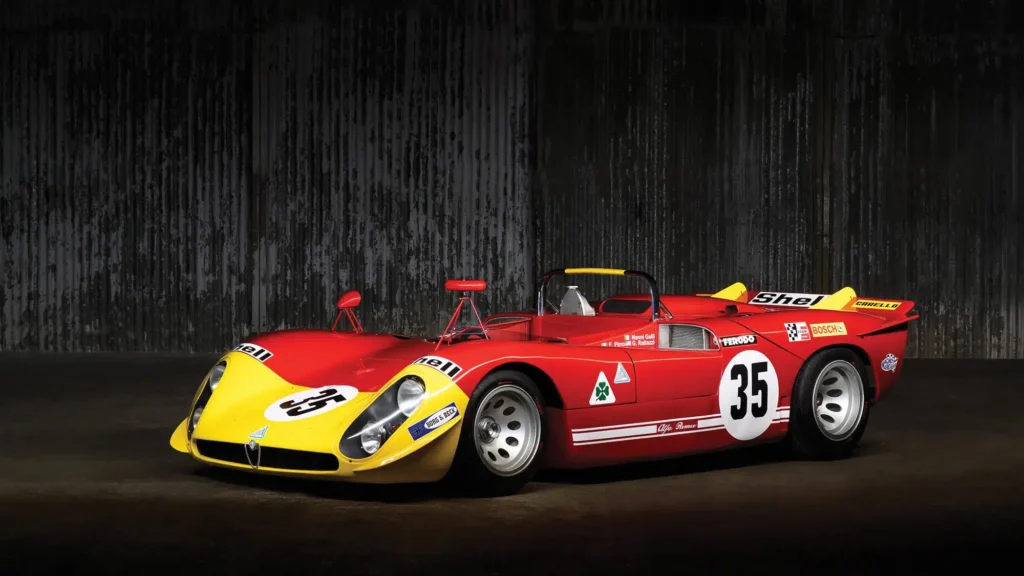
This T33/3 had a supporting role in “Le Mans”, Steve McQueen’s ultra-realistic racing movie.
The 1970 season was much more successful, with a win at the Buenos Aires 1000KM, a 3rd at Sebring, and class wins at Imola and Zeltweg. Le Mans, however, was “what could have been” for Alfa. A 33/3 driven by Rolf Stommelen and Nanni Galli led over 220 laps against the Ferrari 512s and Porsche 917s that were far faster, but the Alfa was disqualified due to receiving outside assistance for a push start. By the end of 1970, Autodelta realized they couldn’t beat the 5-liter cars at any of the faster circuits. This meant that the 33/3 had very little chance of overall victories, so Autodelta made changes to make the 33/3 more competitive on tighter tracks such as the Targa Florio, where the 5-liter cars wouldn’t appear. The main change was smaller 13-inch wheels and a new nose to fit it. This proved a smart choice, and the 1971 season was arguably Autodelta’s best.
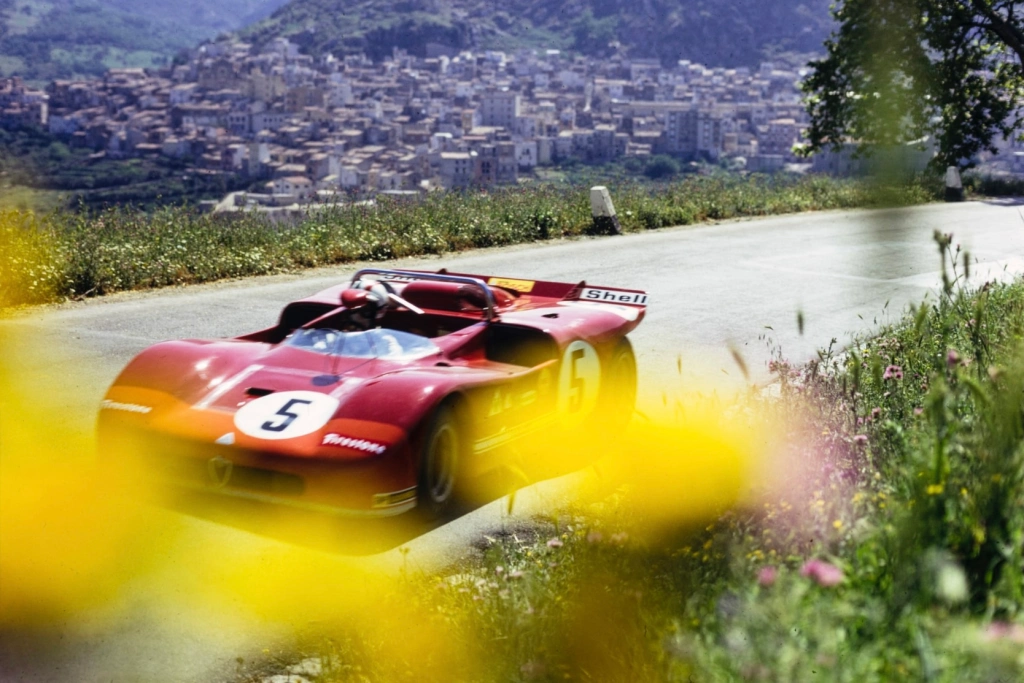
Winning the Targa Florio overall in 1971 was probably Autodelta’s most special win, winning on home soil with local legend Nino Vaccarella.
For 1969, Autodelta decided to upgrade the V8 that powered the 33/2 to 3 liters to compete for overall wins against Porsche, Matra and others. The tube frame of the T33/2 couldn’t handle the 400 horsepower of the upgraded V8, so the new car was built on an aluminum monocoque instead. The fuel tanks were built into the sides of the monocoque, and the transmission was a stressed member. The new car was named Tipo 33/3, even though it shared very little with the old T33/2. The 1969 season was mostly disappointing, with the T33/3 struggling with reliability at most races. Autodelta tested a longtail car for Le Mans, but they skipped the race due to reliability issues.
The updated 33/3 finished second overall at Sebring against the 5-liter cars, and won its class at Monza, Spa, and Zeltweg. The 33/3 even pulled off two unexpected overall wins at Watkins Glen and Brands Hatch. But the triumph at the Targa Florio was easily the highlight of the 1971 season, where the 33/3 defeated Porsche’s ultra-light 908/03 and Ferrari’s 312 PB, and finished 1-2 overall. It was Alfa Romeo’s sixth Targa win, and the first since 1935. Alfa would win one more Targa Florio in 1975, but it was on the much shorter course that lasted until 1977.
Specs: 3.0 Liter V8, 420 horsepower, 193 MPH Top Speed, 1,433 pounds
1972 33/TT/3
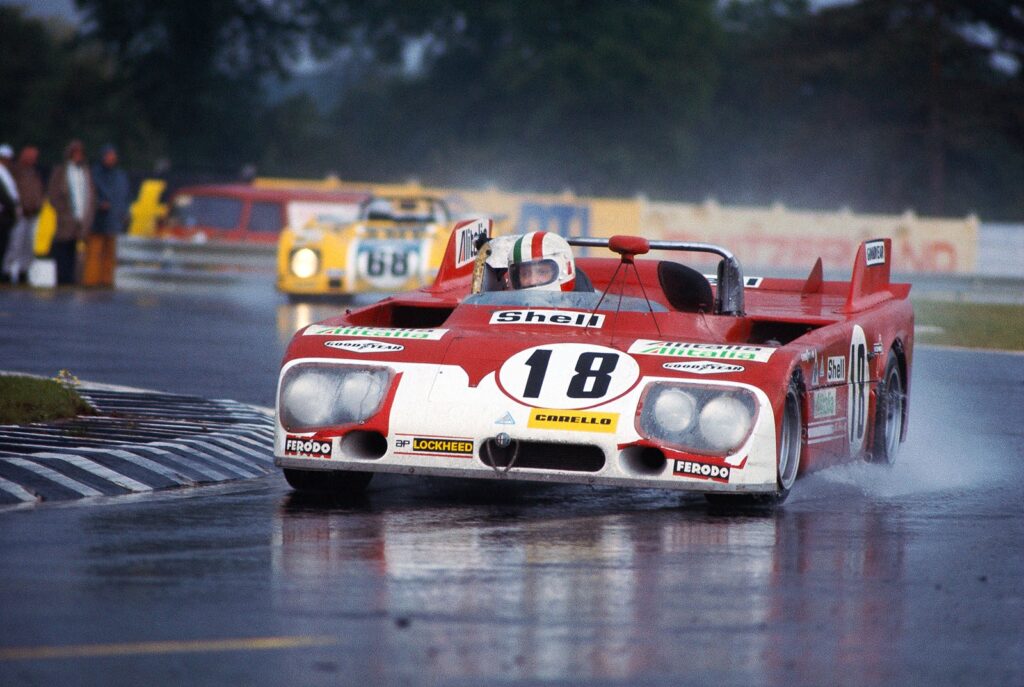
Nino Vaccarella drives his 33/TT/3 through the rain at Le Mans in 1972, followed by Alain De Cadenet’s Duckhams LM.
1972 brought a 3-liter limit on all prototypes after the fiasco of the 512 and 917, and now there would be no way to sneak around the rules. Autodelta decided to build yet another new car, this time with a flat-12 that was very similar to Ferrari’s 312 PB. The new car was christened the 33/TT/3 (TT for tubular chassis). The 33/TT/3 shared very little with the old 33/3, with a new gearbox and a longer wheelbase. The flat-twelve wasn’t ready for 1972, so an upgraded V8 from the 33/3 was used, now making 440 horsepower. Ferrari was the only real competition to Alfa, as Porsche left the WSC to focus on obliterating Can-Am.
Ferrari’s 312 PB was now fully established and would be a serious challenge to beat. It turned out to be an impossible challenge, as Ferrari won every race in 1972 with the Alfa’s sometimes finishing on the podium. The Targa Florio was expected to be won by Ferrari, but they entered only one car, compared with Alfa’s four. Two Alfas dropped out early, but an incredible final stint by a “possessed” Helmut Marko broke the lap record and finished 14 seconds behind the sole Ferrari. A 33/TT/12 managed fourth at Le Mans, the one race that Ferrari didn’t enter as they claimed that their flat-12 wouldn’t last 24 hours. Matra won overall, their first of three Le Mans wins in a row. 1972 would be the last time a Works Alfa Romeo raced at Le Mans. Alfa’s flat-12 was still in development, and some 33/TT/3’s were sold to privateers for 1973, but achieved very little success on the track.
Specs: 3.0-liter flat-12, 470 horsepower, 1477 pounds curb weight, unknown top speed
1974-75 33 TT 12
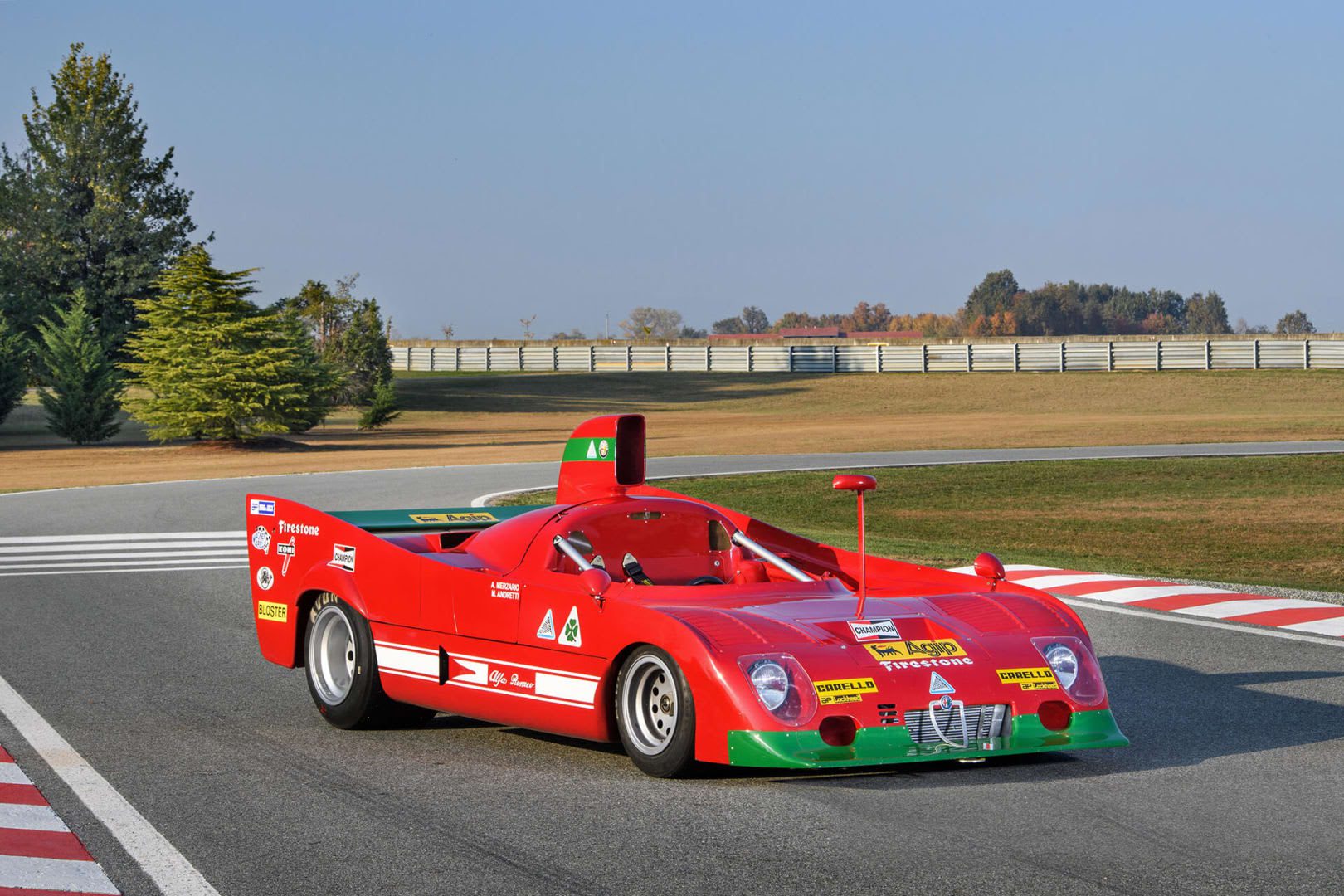
The 33 TT 12 finally delivered the World Championship to Alfa Romeo, admittedly not against the strongest opposition.
The flat-12 that Alfa Romeo had spent more than a year developing was finally ready, and it went into another new car. The 3.0-liter engine was intended for both F1 and the WSC. It made 500 horsepower at a screaming 11,500 rpm, and enough torque to twist the chassis. The 33 TT 12 debuted at the 1973 Spa 1000KM, where it crashed out in practice. The rest of the 1973 season was similarly disappointing, with only one race finish due to reliability issues and crashes. For 1974, the 33 TT 12 was significantly improved, with a large F1-style intake being the most obvious change. The 1974 season started at Monza for the 1000KM, Alfa’s home race. A spectacular 1-2-3 finish on home soil against Matra showed just how much they had improved. But the rest of the championship was another disappointment, as Matra won every other race that year. Autodelta withdrew from the championship halfway through the season to focus on 1975.
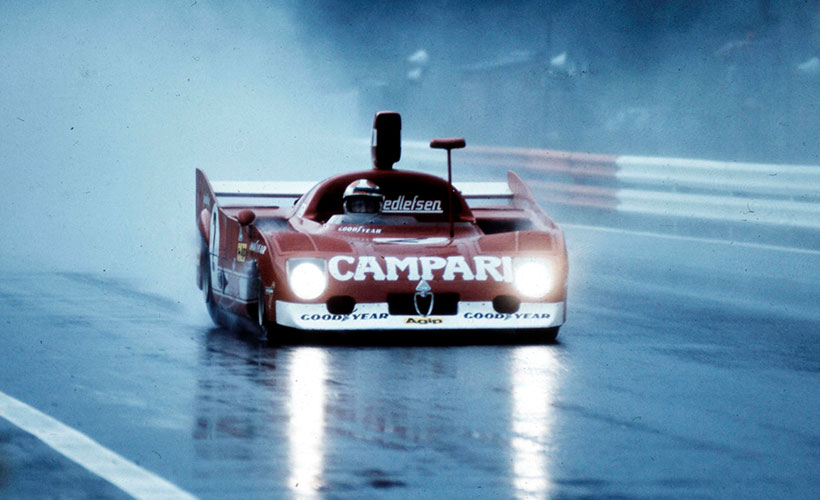
The 33 TT 12 was run by Wille Kahusen’s WKRT team for some of the 1975 season, as the Italian government (which owned Alfa Romeo) no longer wanted to fund racing.
Matra left the championship after the 1974 season, leaving the new Renault-Alpine A442 as Alfa’s only factory opposition. The absence of Ferrari, Matra, and Porsche meant that Alfa Romeo hired some of their top drivers, including Henri Pescarolo, Derek Bell, Mario Andretti, Jochen Mass, Brian Redman, and Jacky Ickx. It wasn’t surprising when Alfa won seven out of nine races and the 1975 championship, with the Renaults and outdated Porsche 908s as the only competition. After 11 years, an Alfa Romeo “33” (which shared nothing with the original Tipo 33) had finally won the World Championship.
Specs: 3.0-liter flat-12, 500 horsepower, 1477 pounds, 205 MPH top speed
1976-77 33 SC 12
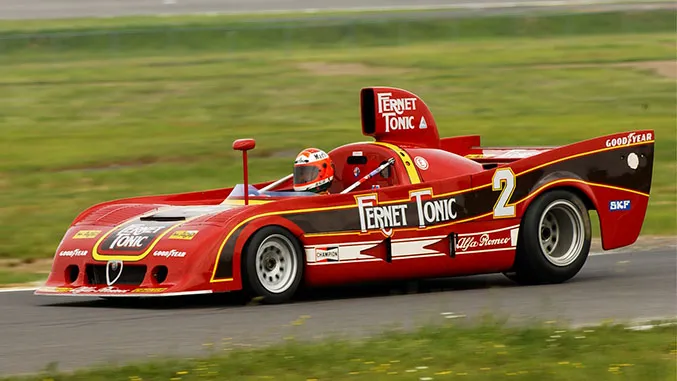
The 33 SC 12 looked very similar to the old 33 TT 12, but it was very different underneath, with a new monocoque chassis and, later, a new 2.1-liter turbo flat-12.
The flat-12 in the 33 TT 12 was so powerful that it twisted the tube-frame chassis, so the Autoidelta engineers decided to build an aluminum monocoque chassis to significantly increase its structural rigidity. The flat-12 now made 520 horsepower. The resulting car was known as the 33 SC 12, with SC standing for Scatolato, or monocoque. By 1976, the championship was a shadow of what it was in previous years, and some races didn’t have any prototypes at all. Alfa Romeo skipped the 1976 season to focus on F1, and Porsche won the championship with their new 936 prototype. The 936 was only raced at Le Mans in 1977, leaving Alfa Romeo as the only works prototype team for the rest of the season. Alfa Romeo won every race in the championship, but no other team was even close in experience, budget, or speed. Alfa Romeo left the championship after 1977 and hasn’t returned since. After ten years in competition, the “33” lineage had won at Le Mans, Daytona, Sebring, and the Targa Florio, as well as two World Championships, although the program encountered many problems over the years. This was the beginning of one of the slower periods in sportscar racing history, as the Porsche 935 became the face of almost every major series and works-entered prototypes were basically nowhere to be seen for several years. But prototypes would return in force at the beginning of the 80’s, with Group C and, later, IMSA GTP. Autodelta, however, was shut down in 1986 after turmoil within Alfa Romeo led Carlo Chiti to leave and start his own engine-building company, Motori Moderni. While they have competed in touring cars many times over the years, Alfa Romeo hasn’t been seen in F1 or sports cars as a factory team since.
Specs: 2.1 liter twin-turbo flat-12, 640 horsepower, 1,700 pounds curb weight, 218 MPH top speed
2025 33 Stradale
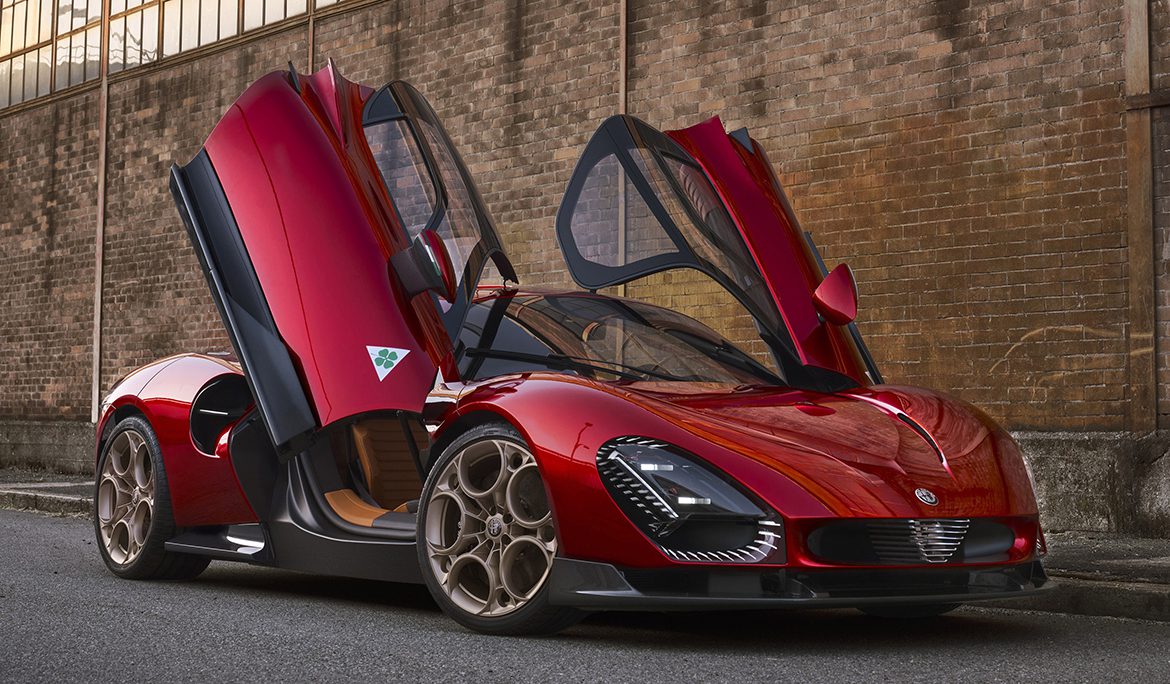
The new 33 Stradale doesn’t change many design elements from the old 33, but that’s not a bad thing.
Surprisingly, Alfa Romeo brought back the 33 name recently for a new, limited-production supercar. Based on the Maserati MC20 with very few changes underneath (both Alfa and Maserati are under the same Stellantis umbrella), the new 33’s main selling point is its beautiful bodywork, which pays tribute to the original 33 Stradale design. It is powered by a 3.0-liter twin-turbo V6 with 620 horsepower. An electric version was planned for the MC20, but both were canned due to basically no demand. Inside, the gorgeous machined-metal center console and dashboard stand out from most modern supercars. Only 33 of them will be built for well over a million dollars. It is a very cool car, but making more than 33 of them would have been nice, as these will probably be incredibly rare to see on the road.
Photo Credits: Cover: Rainer W. Schlegelmilch Tipo 33 “Fleron”: unknown, Bonhams, 1967 33 Stradale: unknown, unknown Tipo T33/2 “Daytona”: Kidston Motorcars, Schaltkulisse T33/3: Motor Sport, Rainer W. Schlegelmilch 33/TT/3: Rainer W. Schlegelmilch 33 TT 12: Girardo & Co, unknown 33 SC 12: unknown